
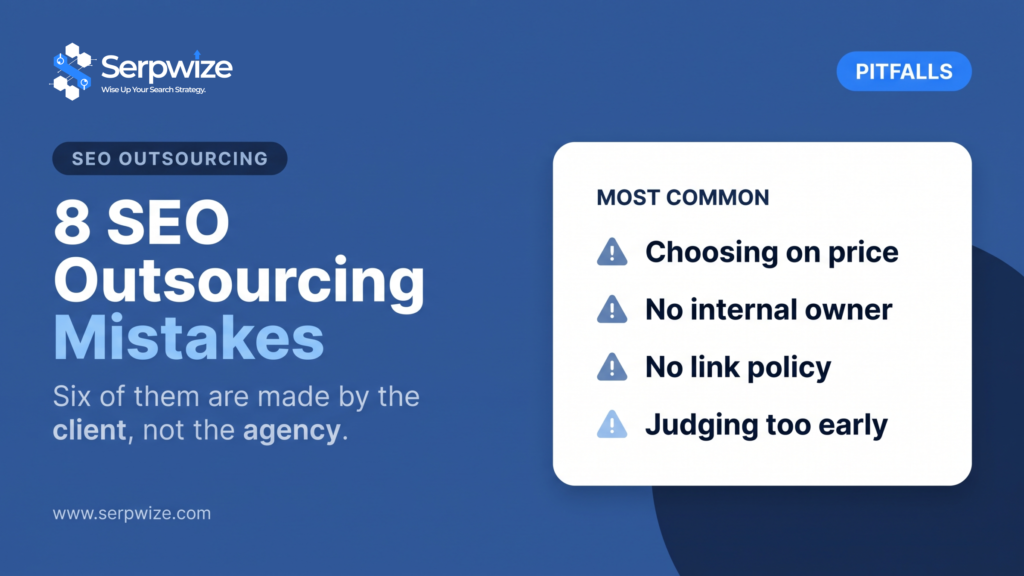
These eight mistakes account for most failed SEO outsourcing engagements. Six of them are made by the client, not the agency, which is the part buyers rarely expect.
1. Choosing on price
The most expensive mistake. Below roughly $500 a month there are not enough senior hours in an engagement for strategy to exist, so you buy execution without direction — usually bulk content and network links.
Instead: set your budget band before hearing pricing, and compare on hours-by-seniority rather than headline cost.
2. Having nobody internally own it
The single most common cause of drift. Approvals stall, developer tickets sit, and the agency retreats to work that needs no permission — which is the work that matters least.
Instead: name one person with 2-4 hours a week and the authority to unblock. Do this before you sign anything.
3. Not contracting the link policy
The only mistake that causes lasting damage. Network and paid links take six to twelve months to unwind through disavowal and pruning.
Instead: forbid paid links and PBNs explicitly, require a monthly report of every new link with a live URL, and put remediation cost on the provider.
4. Judging on rankings at 90 days
Rankings do not move meaningfully in a quarter. Judging on them early makes you cancel good engagements and keep bad ones that got lucky.
Instead: judge process at 90 days — was the audit specific, did fixes ship, was content on cadence and on-brief — and results at six months.
5. Skipping the paid audit
Buyers commit to twelve months without ever seeing how a provider thinks. A $400-$2,500 audit is the cheapest available insurance.
Instead: pay your final two candidates for an audit and compare prioritisation, specificity, and implementability.
6. Giving no brief and expecting market knowledge
An external team cannot invent your customers’ objections or your sector’s vocabulary. Without a brief you get competent generic content, then blame the agency for it.
Instead: build a real onboarding pack — glossary, competitor list, tone samples, and above all the five objections prospects raise before buying.
7. Reviewing everything, or nothing
Clients who approve every internal link make engagements slow and expensive. Clients who approve nothing get generic output published under their name.
Instead: review facts, claims, and brand voice closely. Leave keyword targeting, internal linking, schema, and tooling to the specialists.
8. Letting the provider own accounts
Agencies that create your Analytics property, Search Console, or Google Business Profile under their own ownership can hold the engagement hostage on exit.
Instead: you own every account. Grant delegated access under named individual logins. Revocation should take two minutes.
The pattern
Six of these eight are client-side. Outsourcing does not remove the need to manage the work; it changes who does the work while leaving direction, context, and decisions with you. Engagements fail far more often from absent ownership than from incompetent agencies.
Frequently asked questions
What is the biggest mistake when outsourcing SEO?
Choosing on price. Below $500 a month there are not enough senior hours for strategy, so you get execution without direction and often bulk content and purchased links.
Why do SEO outsourcing engagements fail?
Most often because nobody on the client side owns the relationship. Approvals stall and the agency defaults to low-value work that requires no permission.
Which mistake causes permanent damage?
Not contracting the link policy. Purchased and network links are the one thing that takes six to twelve months and real money to undo.
When should I judge whether it is working?
Process at 90 days, results at six months, ROI at twelve. Judging rankings at 90 days leads to cancelling good engagements early.
How much should I review?
Facts, claims, and brand voice closely. Keyword targeting, internal linking, schema, and tooling not at all. Reviewing everything is as damaging as reviewing nothing.
Part of our complete guide to SEO outsourcing.
Serpwize runs outsourced SEO from India for businesses and agencies in the US, UK, and Australia. See how our engagements are structured.