
Most SEO sales calls are designed so you cannot tell the good agencies from the bad ones. Both say “data-driven”, both show case studies, both promise transparency. These fifteen questions are chosen because a competent agency answers them easily and a weak one cannot.
For each, the answer you want and the answer that should end the conversation.
Questions about the work
1. What will you do in the first 30 days, specifically?
Good: a technical audit, an analytics and Search Console review, keyword and intent mapping, a competitor gap analysis, and a prioritised fix list.
Bad: “We start optimising your site.” Vagueness in month one means a template.
2. How many hours a month, split by seniority?
Good: a decomposition, e.g. 6 senior strategy hours, 24 specialist hours, 20 content hours.
Bad: refusal to break it down. A package that will not decompose into hours is a price, not a plan.
3. Who exactly will work on my account, and can I meet them?
Good: named people, and the strategist joins the call.
Bad: “You’ll have a dedicated account manager.” That is a relay, not a practitioner.
4. Where do your links come from?
Good: digital PR, guest contributions, resource-page outreach, with examples you can click.
Bad: a monthly link quota, or any mention of “high DA” volume packages. This is the single most dangerous area.
5. Who writes the content and who edits it?
Good: two different named people, one with sector familiarity, plus a stated position on AI use.
Bad: “Our content team.” Ask again until you get names and a process.
6. How do you decide what to write about?
Good: search demand, business value, and competitive gap, weighted together, mapped to a cluster.
Bad: “We target high-volume keywords in your niche.” Volume without commercial intent is traffic you cannot bank.
Questions about evidence
7. Show me a client in a similar competitive position, not a similar industry.
Good: a case with comparable domain strength and starting point.
Bad: a screenshot of a brand that was already big. Growing an established site is a different problem from growing yours.
8. Tell me about an engagement that failed and why.
Good: a specific story with what they changed afterwards.
Bad: “We’ve never had one.” That means either inexperience or evasion.
9. What did you get wrong in your last strategy call with a client?
Good: a real answer. Search is uncertain; good practitioners revise.
Bad: deflection. Certainty about SEO is a warning sign, not a credential.
10. How do you handle it when rankings drop?
Good: a diagnostic sequence — check for algorithm updates, technical regressions, SERP layout changes, competitor movement — before conclusions.
Bad: “That won’t happen” or immediate blame on Google.
Questions about the relationship
11. What do you need from me, and how much of my time?
Good: a clear ask — content approvals within a set window, developer access, subject-matter interviews, typically 2-4 hours weekly.
Bad: “Nothing, we handle everything.” Engagements with no client involvement produce generic work.
12. What is the contract term and how do I exit?
Good: 90 days initial, then rolling with 30 days’ notice, documentation handed over.
Bad: 12-month lock-in, or vagueness about what you keep on exit.
13. Who owns the accounts, assets, and content?
Good: you do, unambiguously, and they work through delegated access.
Bad: anything where they create or hold accounts in their own name. This is how agencies hold clients hostage.
14. What will you report, and will it change over time?
Good: leading indicators early (indexation, technical health, coverage), lagging ones later (rankings, traffic, pipeline), with the emphasis shifting.
Bad: the same rankings-and-impressions dashboard forever. If month twelve looks like month one, nobody is managing to outcomes.
15. Do you work with any of my direct competitors?
Good: a straight answer, and a willingness to discuss category exclusivity if it matters.
Bad: evasion. In narrow niches this is a genuine conflict.
Three answers that should end the call
- “We guarantee first-page rankings.” Nobody controls Google’s index. The guarantee is either meaningless or it describes keywords with no competition and no value.
- “We’ll build you 50 backlinks a month.” Real links are earned and unpredictable. A quota describes a purchase, and purchased links are the one thing that causes lasting damage.
- A price quoted before anyone looked at your site. A number given without a diagnosis is a number for a template.
To see how one agency answers Google’s own hiring questions, read our page on professional SEO services.
Frequently asked questions
What should I ask an SEO agency before hiring them?
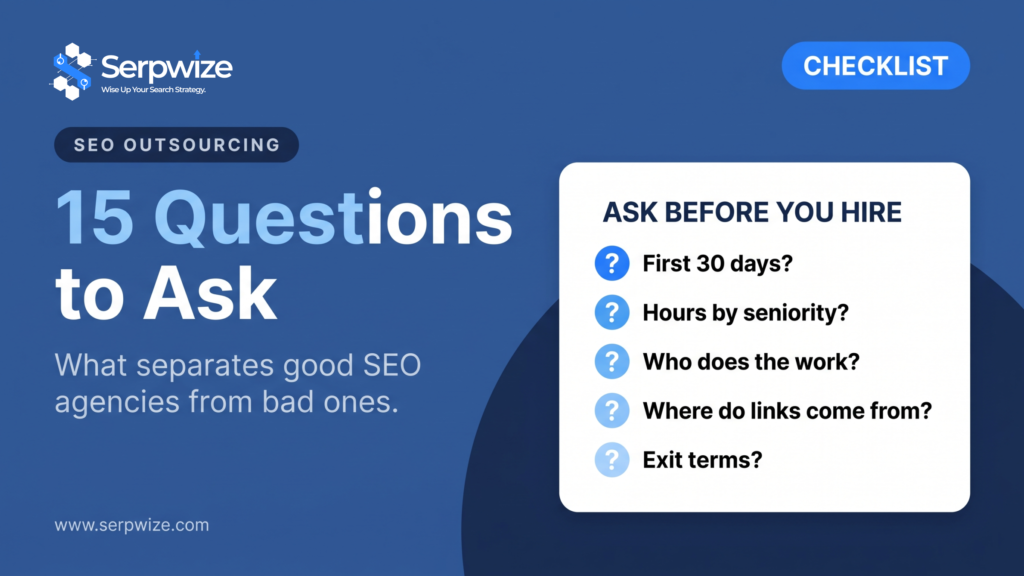
Prioritise five: what happens in the first 30 days, how many hours by seniority, who specifically does the work, where links come from, and what the exit terms are. Those five expose most weak providers on their own.
What are red flags in an SEO proposal?
Guaranteed rankings, a monthly link quota, a price quoted without a site review, tiered packages with no scope detail, and reporting samples that show only rankings and impressions.
Should an SEO agency guarantee results?
No. No agency controls Google’s ranking systems. What they can reasonably commit to is scope, process, timelines, and reporting. A guarantee on outcomes is a sales device.
How do I check an SEO agency’s case studies are real?
Ask for a client in a similar competitive position rather than a similar industry, and ask to speak to a current client directly. Screenshots of already-large brands prove very little about your situation.
Is it normal for an agency to ask for my time?
Yes, and it is a good sign. Expect 2-4 hours weekly for approvals, subject-matter input, and unblocking. An agency claiming to need nothing from you will produce generic work.
Before the call
Send questions 1, 2, 4, and 13 by email in advance. How an agency handles written questions — whether they answer them directly or route around them — tells you most of what the call will confirm.
This article is part of our complete guide to SEO outsourcing. See also how to choose an outsourcing partner and what to put in the contract.
Serpwize runs outsourced SEO from India for businesses and agencies in the US, UK, and Australia. See how our engagements are structured.