
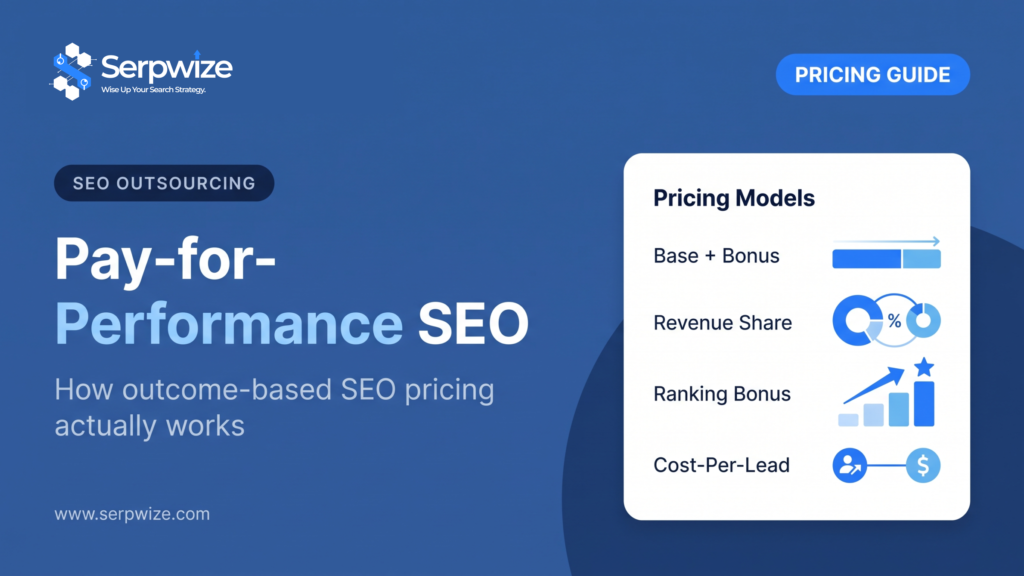
Pay-for-performance SEO sounds like the safest deal in the industry: you only pay when rankings move, traffic grows, or leads show up. In practice it is one of the most misunderstood pricing models in SEO, and it works for far fewer businesses than the pitch suggests.
What Pay-for-Performance SEO Actually Means
Pay-for-performance SEO ties some or all of an agency’s fee to a defined outcome instead of hours or deliverables. The outcome is never “more traffic” in the abstract. It is a specific, contracted metric: a keyword hitting a top-three position, a lead volume threshold, or a revenue share on organic-attributed sales.
No agency runs this model on effort alone. Every real pay-for-performance contract has a base retainer plus a performance bonus, or a performance fee that only kicks in once a floor of work is guaranteed. Pure zero-base, pay-only-on-results SEO does not exist at scale, because SEO work has fixed costs regardless of outcome.
How Pricing Usually Works
| Model | How it works | Best fit |
|---|---|---|
| Base + bonus | Lower flat fee, bonus paid per keyword that hits an agreed rank | Businesses with a short list of high-value keywords |
| Revenue share | Percentage of revenue attributed to organic traffic via UTM or call tracking | Ecommerce and lead-gen businesses with clean attribution |
| Ranking bonus per keyword | Fixed dollar amount per keyword reaching page one | Local businesses targeting a defined keyword set |
| Cost-per-lead | Fee per qualified organic lead, tracked through a CRM | B2B and service businesses with a real sales pipeline |
The Risks Agencies Don’t Advertise
- Easy keywords get picked, not the ones you need. An agency paid per ranked keyword will choose low-competition terms with little commercial value over the harder, high-intent terms that actually drive revenue.
- Rankings can be gamed short-term. Aggressive link building or thin content can push a rank temporarily, collect the bonus, then decay once the site is deprioritised after payout.
- Attribution disputes are common. Revenue-share models fall apart when there is no agreement on what counts as “organic-attributed,” especially with multi-touch buying journeys.
- Technical and content work still needs paying for regardless of outcome. A pure performance model that ignores this either underpays for real work or bakes an inflated bonus into the base to compensate, which defeats the purpose.
When It Actually Makes Sense
Pay-for-performance SEO fits best when there is a small, well-defined, high-value keyword set; clean attribution (call tracking, CRM-linked leads, or ecommerce conversion data); and a contract that specifies exactly what counts as a win, over what time period, measured by which tool.
It fits worst for broad brand-building SEO, content-heavy strategies aimed at topical authority, or any business without reliable tracking. If you cannot say precisely which lead came from which keyword, do not sign a revenue-share contract – you will not be able to verify what you are being billed for.
Frequently asked questions
Is pay-for-performance SEO a scam?
Not inherently, but the model attracts more bad actors than flat retainers because it is easy to promise big numbers with no real accountability behind them. Scrutinise the exact metric, the measurement tool, and the payout trigger before signing anything.
What percentage do agencies charge for revenue-share SEO?
Published rates typically range from 5% to 20% of organic-attributed revenue, depending on margin, average order value, and how competitive the category is.
Can pay-for-performance SEO work for a new website?
Rarely. New sites have no ranking history and no attribution baseline, which makes it hard for either side to agree on what “performance” means in month one. Most agencies require an established site with existing traffic before offering this model.
Is a hybrid model better than pure performance-based pricing?
Usually, yes. A base retainer covering fixed technical and content costs, plus a bonus tied to a specific, trackable outcome, aligns incentives without starving the agency of the budget needed to do the work properly.
Serpwize runs transparent, milestone-based SEO engagements with clear reporting on every metric that matters. See how our SEO outsourcing model works.