
E-commerce SEO is mostly a technical and architectural problem at scale, which makes it one of the better fits for outsourcing. The catch is that the mistakes are catalogue-wide, so a provider without genuine e-commerce experience can damage a lot quickly.
What makes e-commerce SEO different
- Index bloat is the default state. Filters and sort parameters generate thousands of near-duplicate URLs unless actively controlled.
- Category pages carry the commercial value. Most stores over-invest in product pages and under-invest in categories, which is where the head terms sit.
- Products expire. Out-of-stock and discontinued handling is a permanent workflow, not a one-off decision.
- Duplicate content is structural. Variants, manufacturer descriptions, and cross-listed products create it by design.
- Crawl budget genuinely binds once you pass a few thousand URLs.
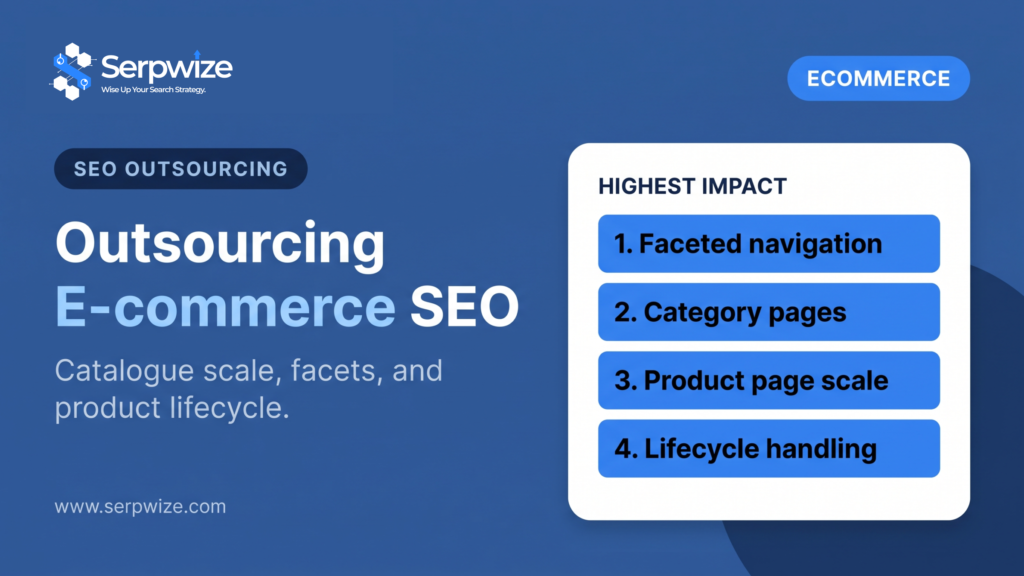
The four highest-impact workstreams
1. Faceted navigation control
Decide which filter combinations are indexable, and enforce it. Colour and size filters generally should not be indexed; a high-demand combination like “waterproof walking boots” often should. This single decision usually has more impact than any content work on a large store.
2. Category page optimisation
Category pages target the commercially valuable head terms. They need genuine content — buying guidance, comparison, sizing help — placed so it does not push products below the fold. Most stores have either no category content or a keyword-stuffed block beneath the footer.
3. Product page scale
Unique descriptions where the product justifies it, templated-but-differentiated where it does not, correct Product schema with price and availability, and review markup. Manufacturer-supplied descriptions used verbatim are duplicate content shared with every competitor.
4. Lifecycle handling
| Situation | Correct handling |
|---|---|
| Temporarily out of stock | Keep the page live and indexed, show restock information |
| Permanently discontinued, replacement exists | 301 to the replacement product |
| Permanently discontinued, no replacement | 301 to the parent category |
| Seasonal product | Keep live year-round; rankings do not rebuild annually |
| Variant pages | Canonical to the parent unless variants have distinct demand |
Deleting discontinued product pages and returning 404s is the most common and most costly e-commerce SEO error.
Vetting an e-commerce provider
Ask these four. Anyone without real e-commerce experience will struggle:
- How would you decide which faceted URLs to index on our store?
- What is your approach to out-of-stock and discontinued products?
- How do you handle variant pages — canonical, noindex, or separate?
- Have you worked on our platform specifically, and what are its known SEO constraints?
Platform experience matters more here than in other SEO work. Shopify, Magento, WooCommerce, and BigCommerce each have distinct and well-known limitations.
What it costs
$1,000-$2,500 a month for a small catalogue under 500 products. $2,500-$6,000 for mid-size. $6,000+ for large catalogues with international or multi-currency requirements. A one-off technical audit for a large store runs $1,500-$5,000 and is the sensible starting point.
Frequently asked questions
Can e-commerce SEO be outsourced?
Yes, and it suits outsourcing well because the work is largely technical and architectural at scale. Insist on demonstrated e-commerce and platform-specific experience.
What has the biggest impact on e-commerce SEO?
Faceted navigation control and category page optimisation. Both usually outweigh product-page content work on a store of any size.
What should happen to discontinued products?
301 to the replacement if one exists, otherwise to the parent category. Never delete and return 404s — that is the most common and most costly error.
How much does outsourced e-commerce SEO cost?
$1,000-$2,500 a month under 500 products, $2,500-$6,000 mid-size, $6,000+ for large or international catalogues.
Does platform experience matter?
Yes, more than in other SEO work. Shopify, Magento, WooCommerce, and BigCommerce each have distinct structural constraints, and a provider who has not worked on yours will spend your budget learning it.
Part of our complete guide to SEO outsourcing.
Serpwize runs outsourced SEO from India for businesses and agencies in the US, UK, and Australia. See how our engagements are structured.