
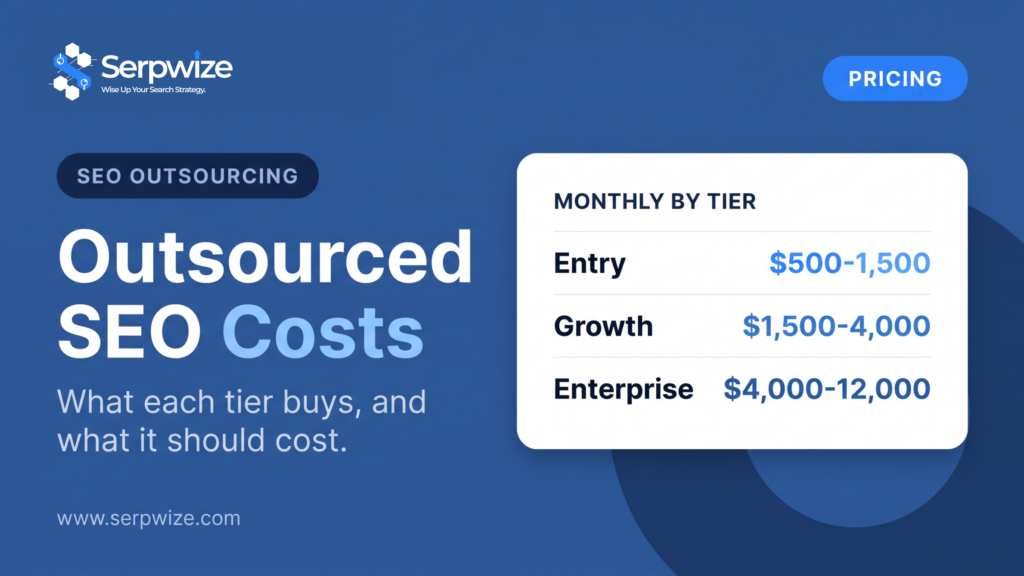
Short answer: outsourcing SEO costs $500–$1,500/month for a small business, $1,500–$4,000/month for a growth-stage brand, and $4,000–$12,000/month for enterprise or multi-location work. Offshore teams in India deliver the same scope at roughly 40–60% of US or UK agency rates. One-off audits run $400–$2,500.
Those are the numbers. The rest of this page explains what actually drives them, which pricing model fits your situation, what you should receive at each tier, and how to tell a genuinely affordable partner from a cheap one that will cost you a recovery project in eighteen months.
SEO outsourcing cost at a glance
| Tier | Monthly (USD) | Monthly (INR) | Best for |
|---|---|---|---|
| Entry / local | $500–$1,500 | ₹40,000–₹1,25,000 | Single-location businesses, one city, one service line |
| Growth | $1,500–$4,000 | ₹1,25,000–₹3,30,000 | Multi-service SMBs, SaaS, competitive niches |
| Enterprise / multi-location | $4,000–$12,000+ | ₹3,30,000–₹10,00,000+ | National campaigns, franchises, e-commerce at scale |
| Technical audit (one-off) | $400–$2,500 | ₹35,000–₹2,00,000 | Diagnosis before committing to a retainer |
| White-label / reseller | $300–$2,500 per client | ₹25,000–₹2,00,000 | Agencies reselling under their own brand |
Indian agencies typically sit at the lower half of every band above while delivering comparable scope. That gap is a labour-cost arbitrage, not a quality discount — provided you vet the partner properly, which is covered further down.
The seven factors that actually move the price
Two quotes for “SEO” can differ by 5x and both be honest. The variance comes from these, in rough order of impact:
- Competition in your niche. Ranking a local plumber and ranking a fintech SaaS are different sports. Competitive verticals need more content, more links, and more senior strategy hours per month.
- Scope of services. Technical SEO only is cheaper than technical plus content plus digital PR plus local. Each added workstream adds cost roughly linearly.
- Content volume. Usually the single largest line item. Four well-researched 1,500-word pieces a month costs materially more than two.
- Link acquisition. Genuine editorial links are expensive and slow. If a quote includes “50 backlinks/month” at a low price, those links are bought or automated, and they are a liability.
- Geographic spread. One city is one Google Business Profile and one set of citations. Forty locations is forty of everything, plus a location-page architecture.
- Site condition at the start. A site with broken canonicals, a bloated index, and no schema needs a remediation phase before growth work begins. Budget one to three months for it.
- Seniority of who touches the account. The real differentiator. Cheap engagements are executed by juniors following a checklist. The strategy is where the value is, and strategy is a senior-hours cost.
Which pricing model should you choose?
| Model | How it works | Use when | Watch out for |
|---|---|---|---|
| Monthly retainer | Fixed fee, agreed deliverables, ongoing | You want compounding growth and predictable budgeting. The default for 80% of engagements. | Vague deliverable lists. Insist on quantities, not adjectives. |
| Project-based | Flat fee, defined scope, finite | A migration, an audit, a one-time site restructure. | Scope creep. Define what “done” means in writing. |
| Hourly | Billed per hour of specialist time | You have an in-house team and need senior input, not execution. | No accountability for outcomes — you are buying time, not results. |
| Performance-based | Fee tied to rankings, traffic, or leads | Rarely the right answer. | Incentivises easy-win keywords with no commercial value. Attribution disputes are near-certain. |
| White-label / per-client | Wholesale rate, you resell at your margin | You are an agency adding SEO without hiring. | Confirm who owns the client relationship and the reporting. |
For most businesses the monthly retainer wins because SEO compounds. Stopping and restarting resets momentum, and the first ninety days of any engagement are largely setup you have already paid for.
What you should get for the money, by tier
Entry tier ($500–$1,500/month)
- Technical audit and fixes for crawl, indexation, Core Web Vitals
- Keyword and intent mapping for 20–50 target terms
- On-page optimisation across existing pages: titles, headings, internal links, schema
- Two to four content pieces per month
- Google Business Profile management and local citation cleanup
- Monthly reporting against agreed KPIs
Growth tier ($1,500–$4,000/month)
Everything above, plus:
- Topical cluster strategy rather than isolated posts
- Four to eight content pieces monthly, including commercial landing pages
- Active link acquisition through digital PR and genuine outreach
- Competitor gap analysis on a recurring cycle
- Conversion-rate work on the pages that already rank
- Entity and AI-visibility optimisation for AI Overviews and answer engines
Enterprise tier ($4,000–$12,000+/month)
Everything above, plus:
- Programmatic or template-driven page architecture at scale
- Multi-location or multi-market strategy with hreflang where relevant
- Log-file analysis and crawl-budget management
- Dedicated senior strategist and named delivery team
- Custom dashboards and integration with your BI stack
If a proposal at one tier is missing several items from that tier’s list, you are not comparing like with like — regardless of what the headline number says.
Affordable is not the same as cheap
This distinction costs businesses more money than any other in SEO procurement. Affordable means a fair rate for real senior work, usually achieved through labour arbitrage or operational efficiency. Cheap means the work itself has been substituted for something that only looks like the work.
| Affordable | Cheap | |
|---|---|---|
| Content | Researched, edited, subject-matter reviewed | Bulk-generated, unedited, thin |
| Links | Earned through outreach or PR, few and relevant | Bought in volume from link networks |
| Strategy | Custom to your market and site condition | Identical checklist applied to every client |
| Reporting | Revenue and pipeline metrics | Impressions and “keywords improved” |
| Who does the work | Named specialists you can speak to | Anonymous, high-turnover, offshore-of-the-offshore |
| Real cost | The invoice | The invoice, plus a recovery project later |
The recovery cost is the part buyers underestimate. Disavowing a toxic link profile and pruning hundreds of thin pages typically takes six to twelve months of no growth. Weighed against that, the monthly saving on a cheap retainer disappears entirely.
SEO costs for a small business, specifically
Small businesses have a genuine constraint, so the question is not just what SEO costs but what the minimum viable spend is that still produces compounding results.
Below roughly $500/month, retained SEO rarely works. At that level there are not enough hours for both strategy and execution, so you get execution without direction. If that is your ceiling, the better allocation is:
- A one-off technical audit and fix-list ($400–$1,200), implemented once and done properly
- Google Business Profile optimisation, which for a local business often returns more than any other single activity
- Three to five commercial pages written properly, rather than twenty written cheaply
- Revisit a retainer once those assets exist and there is something to compound
Signs it is time to increase spend: rankings have plateaued for two consecutive quarters, you are expanding into new locations or service lines, or competitors have started outranking you on terms you previously owned.
Pricing red flags
- Guaranteed rankings. Nobody controls Google’s index. A guarantee is either meaningless or describes zero-competition keywords.
- A quoted link count. Real links are earned and unpredictable. A number implies a purchase.
- No audit before the quote. A price given without seeing your site is a price for a template.
- Twelve-month lock-in with no exit. Ninety days to prove process, then rolling, is reasonable. A year of no recourse is not.
- Reporting that never mentions revenue. If quarter three’s report shows the same metrics as month one’s, nobody is managing to outcomes.
- Unwillingness to name who does the work. You should know your strategist’s name and be able to speak to them.
Frequently asked questions
How much does it cost to outsource SEO per month?
Between $500 and $12,000 per month depending on tier. Most small and mid-sized businesses land between $1,000 and $3,000. Indian agencies deliver comparable scope at roughly 40–60% of US or UK rates.
Is outsourcing SEO cheaper than hiring in-house?
Usually, yes. A single mid-level in-house SEO costs $60,000–$90,000 annually in salary alone in the US, before tools, benefits, and the fact that one generalist cannot cover technical, content, and link acquisition. An outsourced team supplies all three disciplines for less than that headcount.
How long before outsourced SEO pays for itself?
Expect early technical and on-page gains within 60–90 days, meaningful ranking movement at four to six months, and clear ROI between months six and twelve. Anyone promising faster is describing paid search, not SEO.
What is a fair price for an SEO audit?
$400–$2,500 depending on site size. Under $400 is likely a tool export with a cover page. The deliverable should be a prioritised, implementable fix-list, not a 90-page PDF of automated warnings.
Should I pay for SEO based on results?
Generally no. Performance pricing pushes agencies toward keywords that are easy to rank rather than keywords that generate revenue, and attribution disputes are almost guaranteed. A retainer with clearly defined deliverables and a ninety-day review is a better structure.
Working out your own number
Start from what a customer is worth to you rather than from what agencies charge. If a client is worth $3,000 in lifetime value and SEO needs to produce four extra clients a month to justify itself, a $2,000 retainer that delivers is cheap and a $600 retainer that does not is expensive.
Then check three things in any proposal: is the scope quantified, is the strategist named, and is there a defined review point. Those three answers separate a real engagement from a template more reliably than the price does.
Serpwize runs outsourced SEO from India for businesses and agencies in the US, UK, and Australia. If you want a scoped quote rather than a package list, see how our SEO outsourcing engagements work or tell us about your site and we will send a costed plan.
This article is part of our complete guide to SEO outsourcing — covering cost, partner selection, contracting, and day-to-day management.