
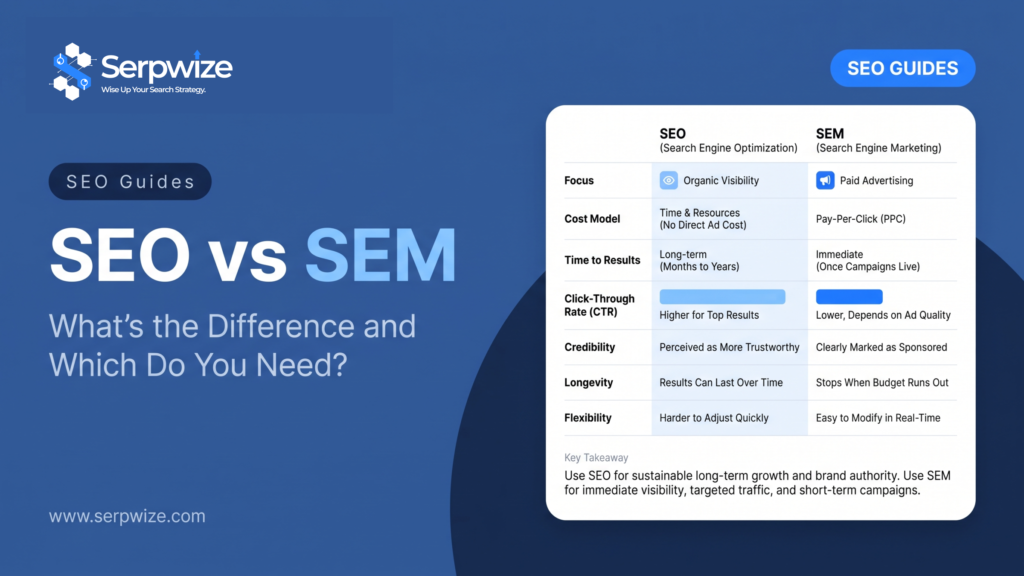
SEO and SEM both aim to get your business found on a search results page, but they work in opposite ways: SEO earns organic rankings through relevance and authority signals, while SEM (in current everyday usage) means paid search advertising, where you bid to appear above the organic results for a chosen keyword. The two are not competitors so much as different tools for different timelines — SEM buys visibility today, SEO builds visibility that compounds over months and keeps working after you stop paying for it.
The term SEM originally meant “search engine marketing,” an umbrella covering both SEO and paid search together. In practice, almost everyone now uses SEM to mean paid search specifically — Google Ads, Microsoft Ads, and similar pay-per-click platforms. That drift in meaning is the single biggest source of confusion in this comparison, so this guide uses SEM in its modern, common sense: paid search advertising.
The Core Difference
- SEO (Search Engine Optimisation) — earns rankings in the organic results through technical SEO, content relevance, and off-page authority signals like backlinks and citations. No per-click cost, but it takes time to build and compete for competitive terms.
- SEM / PPC (Paid Search) — buys placement above or alongside the organic results through an auction-based bidding system. Visibility is immediate, but it stops the moment you stop paying, and cost scales directly with traffic volume.
Cost Structure
SEO is a time and expertise investment: you pay for the work of building and maintaining rankings, not for each visitor who clicks through. Once a page ranks well, it can keep generating traffic for months or years with only maintenance effort. SEM is the opposite: every click has a direct cost, set by an auction against competitors bidding on the same keyword, and traffic stops the instant the budget runs out or the campaign pauses.
Speed to Results
This is where SEM has a genuine, uncontested advantage: a paid campaign can be live and generating clicks within hours of launch. SEO realistically takes weeks to months to show meaningful movement, since it depends on Google crawling, indexing, and building trust in a page over time, and competitive terms take longer than low-competition ones. If a business needs traffic this week, SEO alone cannot deliver that, regardless of how well it is executed.
Long-Term Value
The picture reverses over a longer horizon. A well-optimised page that earns real backlinks and citations keeps ranking, and keeps generating free traffic, long after the initial work is done. A paid campaign generates zero residual traffic once spending stops — there is no compounding effect, only a direct trade of budget for clicks. This is why most serious search strategies use SEO for durable, compounding visibility and reserve paid search for specific short-term needs: a product launch, a seasonal push, or testing which keywords actually convert before committing SEO effort to them.
Do You Actually Need Both?
For most businesses, the honest answer is that SEO and PPC data can inform each other even if you only run one. PPC campaigns generate fast, real conversion data on which keywords and ad copy actually drive business results, which is genuinely useful input for prioritising SEO content and target keywords, even if you never run PPC long-term. Conversely, a business with strong organic rankings already often finds paid search on the same terms delivers a worse return, since it is paying for clicks it would get for free anyway.
This is where the comparison breaks down as a simple either/or choice. The better question is not “SEO or SEM” but “what is this specific traffic goal, and what is the realistic timeline for it.” A new product needing visibility this month is a PPC problem. A business trying to build a defensible, compounding organic presence over the next year is an SEO problem. Most growing businesses eventually need both, run by people who understand how the data from one should inform the other.
SEO vs SEM Checklist
- Need traffic within days, not months? SEM is the only option that can deliver that timeline
- Building for the next 12+ months? SEO compounds, SEM does not
- Testing which keywords actually convert? PPC data is faster and cheaper to gather than waiting on organic rankings
- Already ranking well organically for a term? Paying for the same click via PPC is usually a poor return
- Limited budget long-term? SEO has a better cost trajectory once initial rankings are established
A Practical Example: New Business vs Established Business
A brand-new business with zero online history has no organic rankings to lose and no existing traffic to protect. For this business, SEM makes sense immediately: it generates visibility and real customer data from day one, while SEO work runs in parallel in the background, since it will not show meaningful results for months regardless of how it is started. Running SEM alone for the first quarter while SEO groundwork gets laid is a common, sensible sequence.
An established business with three years of decent organic rankings faces the opposite calculation. Paying for clicks on terms it already ranks well for is close to pure waste, since it would get most of that traffic for free. For this business, SEM makes more sense targeting genuinely new terms, competitor brand searches, or a specific seasonal campaign, while ongoing SEO investment protects and extends the existing organic base that took years to build.
The mistake both businesses can make is applying the wrong playbook: a new business waiting passively for SEO to work without any interim visibility strategy, or an established business continuing to pay for clicks it has already earned organically. The right channel mix depends entirely on what already exists, not on a generic industry rule of thumb.
Frequently Asked Questions
Is SEM the same as PPC?
In current everyday usage, yes, most people use SEM and PPC interchangeably to mean paid search advertising. Technically, SEM originally meant the combination of SEO and paid search together, but that broader definition has largely fallen out of common use.
Which is cheaper, SEO or SEM?
It depends on the timeframe. SEM has a lower barrier to entry (you can start today with any budget) but every visitor has a direct, ongoing cost. SEO typically costs more upfront in time and expertise, but a page that ranks well keeps generating traffic without a per-visitor cost, which usually makes it cheaper per visitor over a longer horizon.
Can I do SEO and SEM at the same time?
Yes, and for many businesses this is the most effective approach: PPC covers the immediate visibility gap while SEO work builds toward compounding, free traffic. The two channels also share useful data, since PPC search-term reports reveal real customer language that can directly inform SEO content and keyword targeting.
Why did rankings not improve after a month of SEO work?
A month is genuinely too short to judge most SEO work. Google needs to recrawl and reassess a page, and competitive terms take considerably longer than low-competition ones. Real movement typically starts showing in the 60 to 90 day range, with stronger compounding gains from month four onward.
Does stopping SEO work mean losing rankings immediately?
Not immediately, but the advantage erodes over time. Existing content, backlinks, and technical fixes do not disappear the day work stops, but competitors who keep actively building authority and content will eventually overtake a site that has gone static, since search rankings reflect an ongoing competitive comparison, not a one-time achievement.
Related reading: Off-Page SEO: The Complete Guide
Want to know which channel actually makes sense for your specific timeline and budget? Book a free strategy call and we will map out a real plan, not a generic recommendation.