
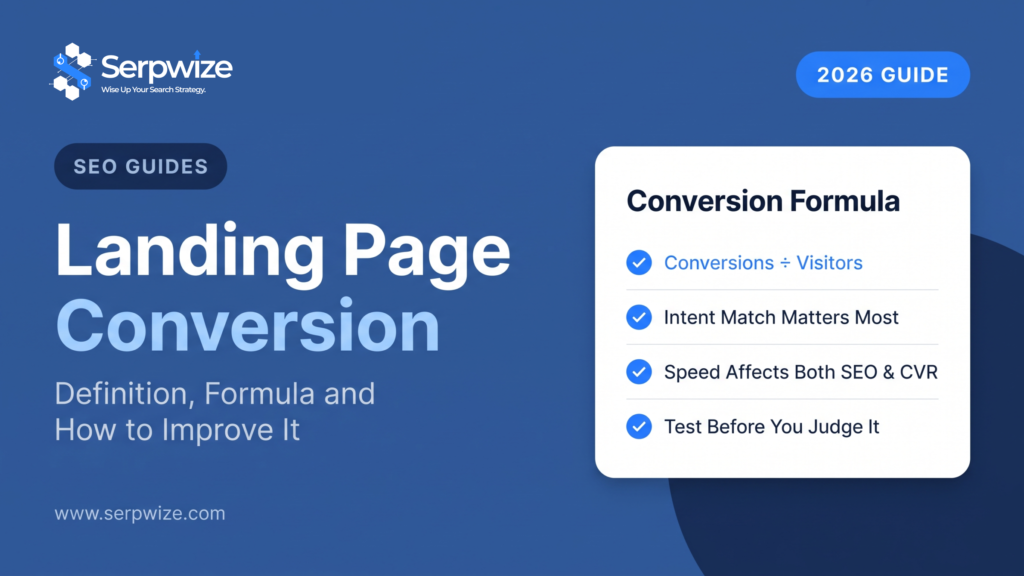
Landing page conversion is the percentage of visitors to a specific page who complete the action that page was built for, whether that is submitting a lead form, making a purchase, booking a call, or clicking through to a phone number. It is calculated as conversions divided by total visitors, multiplied by 100. A landing page that gets 1,000 visitors and 30 completed actions has a 3% conversion rate.
The concept only makes sense once you define what a “conversion” actually is for that specific page, and that definition changes by business and by page. A SaaS trial signup page converts on a completed signup. A local trades page converts on a phone click or a form submission. An ecommerce product page converts on an added-to-cart or a completed purchase. Measuring “conversion” without first pinning down which action counts is the most common reason conversion data gets misread.
The Landing Page Conversion Rate Formula
Conversion rate = (number of conversions ÷ number of visitors) × 100. The part that trips people up is not the formula, it is deciding what to count as a visitor and what to count as a conversion. Bot traffic, accidental clicks, and visitors who bounce in under a second should generally be excluded from the visitor count if you want a rate that reflects real intent, not raw traffic volume.
What a “Good” Conversion Rate Actually Looks Like
Industry benchmarks commonly cited for landing pages sit somewhere in the 2% to 5% range, but that figure is close to meaningless without context. A brand-search landing page for someone actively looking to buy converts at a very different rate than a cold-traffic page targeting a broad, top-of-funnel keyword. Traffic source, search intent, offer clarity, and page load speed all move this number independently, which is why comparing your conversion rate to a generic industry average is rarely useful. Comparing it to your own page’s past performance, or to a genuinely similar traffic source, is.
Landing Page Conversion vs Site-Wide Conversion Rate
These are often confused but measure different things. Landing page conversion rate looks at one specific page in isolation, usually one built for a single, focused action. Site-wide conversion rate blends every page and every traffic source together, which can hide a strong-performing landing page inside a weak overall average, or the reverse. If you are optimising a specific campaign or a specific piece of content, the page-level number is the one that actually tells you whether that page is doing its job.
How Traffic Quality Affects Landing Page Conversion
The single biggest lever most people overlook is not the page itself, it is who is landing on it. A visitor who searched an exact-match, high-intent phrase and clicked through to a page that directly answers that search converts at a fundamentally different rate than a visitor who clicked a broad or loosely related ad. This is one of the real, practical differences between organic search traffic and paid traffic: SEO tends to bring visitors already close to the intent the page is built for, while paid traffic can bring a wider, less pre-qualified audience unless the targeting is unusually tight. Neither is universally better, but they need to be read differently when you are looking at a conversion number.
Common Reasons Landing Pages Underperform
- Mismatch between what brought the visitor there and what the page delivers — a page that does not directly answer the search or ad that led to it loses visitors immediately, regardless of how well-designed it is.
- Slow load speed — page speed affects both conversion and SEO rankings independently, and a slow landing page loses visitors before they ever see the offer.
- An unclear or buried call to action — if the next step is not obvious within a few seconds, most visitors will not look for it.
- Weak trust signals — no reviews, no real contact details, no evidence of a real business behind the page, especially damaging for local or service businesses.
- Asking for too much too soon — a long form or a big commitment on a first visit filters out visitors who would have converted on a smaller first step.
Where This Overlaps With SEO
Landing page conversion and SEO are not separate disciplines competing for the same page, they reinforce each other in ways that are easy to miss. Core Web Vitals and page speed are real ranking factors and a real driver of conversion at the same time, so fixing one genuinely helps the other. Content that closely matches real search intent, the same principle that improves organic rankings, is also the content most likely to convert once a visitor actually lands on the page. A page built purely for SEO with no regard for what happens after the click, or purely for conversion with no regard for how it will actually be found, both leave real value on the table.
Frequently Asked Questions
What counts as a good landing page conversion rate?
There is no single good number. A 2% to 5% range is commonly cited, but the right benchmark is your own page’s historical performance and genuinely comparable traffic sources, not a generic industry average that blends every business model and traffic type together.
Is landing page conversion rate the same as click-through rate?
No. Click-through rate measures how many people clicked a link, ad, or search result to arrive at the page. Conversion rate measures what percentage of those visitors then completed the page’s actual goal once they arrived. A page can have a high click-through rate and a low conversion rate if it fails to deliver on what got the click.
Does SEO traffic convert better than paid traffic?
It depends on intent match, not the channel itself. Organic search traffic that matches a specific, high-intent query tends to convert well because the visitor is already close to the action the page supports. Paid traffic can convert just as well, or better, when targeting is tight, and worse when it is broad. The channel is less predictive than how closely the traffic’s intent matches the page.
How long should I test a landing page before judging its conversion rate?
Long enough to gather a statistically meaningful sample, which depends on traffic volume, not a fixed number of days. A page getting a handful of visitors a day needs weeks to produce a reliable number; a high-traffic page can show a reliable trend within days. Judging a page on a few dozen visitors risks reading noise as a real signal.
Can a landing page have a high conversion rate and still be bad for SEO?
Yes, if it is built purely for conversion with thin content, no real heading structure, or duplicate content copied from another page. The reverse is also true: a page built purely for search rankings with no clear next step for the visitor can rank well and still convert poorly. Both need to be considered together, not traded off against each other.
Related reading: SEO vs SEM: What’s the Difference and Which Do You Need?
Getting real search traffic to a page is only half the job if that traffic does not convert once it lands. Book a free strategy call and we will look at how your actual search traffic is behaving once it reaches your site.