
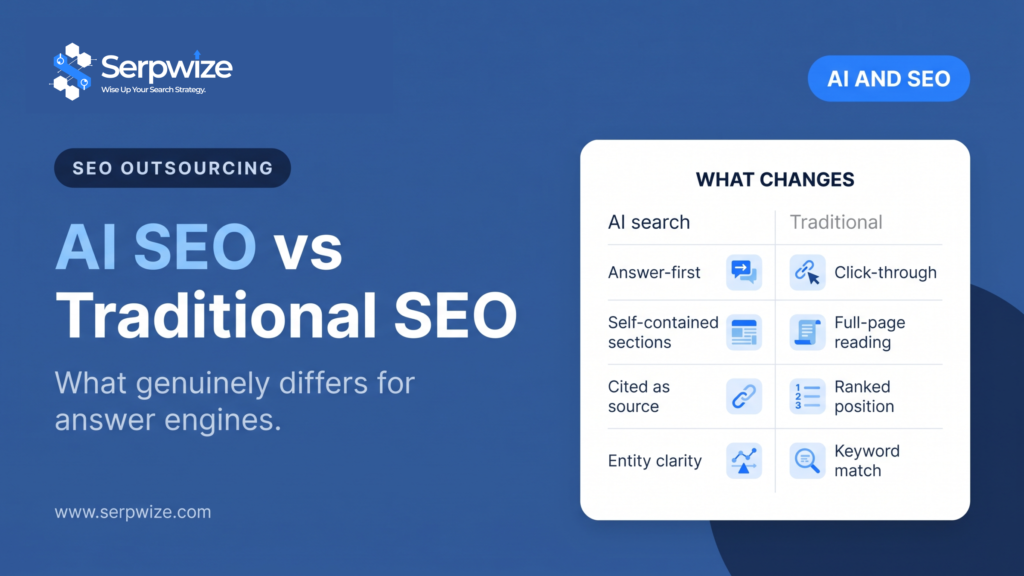
“AI SEO” is not a separate discipline. It is traditional SEO with AI applied to parts of the workflow, plus a genuinely new objective: being cited by answer engines rather than only ranked by search engines. Those two things get conflated constantly, usually by people selling one of them.
Two different claims, separated
| AI-assisted delivery | Optimising for AI search | |
|---|---|---|
| What it means | Using AI in research, drafting, analysis | Getting cited in AI Overviews and answer engines |
| Is it new? | New tooling, same objective | Genuinely new objective |
| Should you pay more? | No — it lowers the provider’s cost | It is part of competent modern SEO, not a premium add-on |
| Risk | Unedited output published at volume | Chasing citation while neglecting commercial rankings |
An agency charging a premium for “AI SEO” because it uses AI internally has the economics backwards. AI reduces their production cost; it does not increase your value received.
What actually differs when optimising for answer engines
- Answer-first structure. A direct answer in the opening lines, before context. Extractable in isolation.
- Self-contained sections. Each heading’s content should make sense pulled out of the page, because that is how it gets used.
- Explicit entities. Name things fully rather than relying on pronouns and prior context.
- Verifiable claims. Specific, sourced statements are cited; vague ones are not.
- Structured data. FAQ, HowTo, and Article schema make extraction easier.
- Consistency across the web. Answer engines synthesise from many sources, so consistent facts about your business across your site, profiles, and mentions matter more than they did.
Notice none of these conflict with traditional SEO. Clear structure, specific claims, and correct schema were always good practice. Answer engines have raised the penalty for not doing them.
What has not changed at all
- Technical health still caps everything. Unindexed pages are not cited either.
- Authority still determines whether you are used as a source.
- Commercial intent queries still resolve to websites, because people buy on websites.
- Links still signal credibility, to both systems.
- Genuine expertise still differentiates, and now more sharply.
Where the balance should sit
Informational queries increasingly resolve inside the AI answer, so traffic to purely informational content is falling. Commercial and transactional queries still send clicks, because someone comparing vendors or ready to buy visits sites.
The practical implication: shift weight toward commercial pages, and treat informational content as a citation and authority play rather than a traffic play. That is a change of emphasis within traditional SEO, not a replacement of it.
How to evaluate a provider claiming AI expertise
- “Where do you use AI, and who edits the output?” Research and drafting is fine. No named editor is not.
- “How do you measure AI visibility?” A real answer involves tracking citations across answer engines. A vague one means it is marketing.
- “What would you do differently for AI search versus traditional?” If the answer is “everything”, they are selling. If it is a specific list of structural changes, they understand it.
- “Has your pricing changed since AI reduced production cost?” An honest provider has an answer.
Frequently asked questions
What is the difference between AI SEO and traditional SEO?
AI SEO usually means one of two things: using AI in the delivery workflow, or optimising to be cited by answer engines. The first is a tooling change with the same objective. The second is a genuinely new objective, but it uses the same fundamentals.
Should I pay more for AI SEO?
No. AI lowers a provider’s production cost. Optimising for answer engines is part of competent modern SEO, not a premium service line.
Is traditional SEO obsolete?
No. Technical health, authority, and links determine whether you are cited by answer engines just as they determine whether you rank. Commercial queries still resolve to websites.
How do I optimise for AI Overviews?
Answer-first structure, self-contained sections, explicit entity naming, specific verifiable claims, correct schema, and consistent facts about your business across the web.
Should I stop publishing informational content?
No, but change what you expect from it. Treat it as a citation and authority play rather than a traffic play, and shift weight toward commercial pages.
Part of our complete guide to SEO outsourcing.
Serpwize runs outsourced SEO from India for businesses and agencies in the US, UK, and Australia. See how our engagements are structured.