
Canonicalization SEO is the process of telling search engines which version of a page is the “master” copy when multiple URLs show the same or very similar content – filtered product listings, tracking-parameter URLs, or www vs non-www variants, for example.
What a Canonical Tag Does
A canonical tag, written as <link rel="canonical" href="..." /> in a page’s head, tells search engines which URL should receive ranking credit when duplicate or near-duplicate versions exist. It consolidates signal onto one URL instead of splitting it across several.
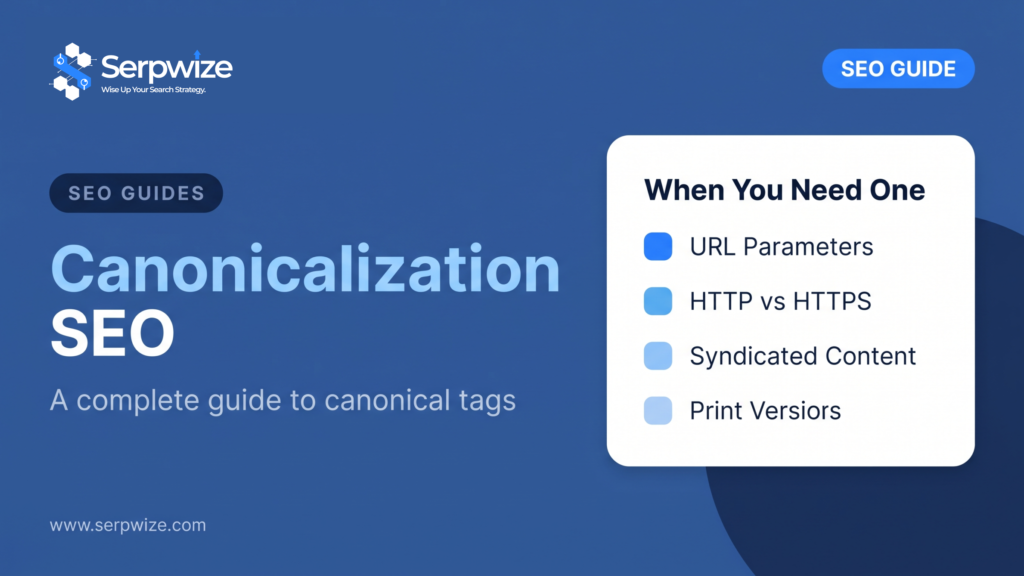
When You Need One
- URL parameters from tracking, sorting, or filtering that create technically different URLs for the same content.
- HTTP vs HTTPS or www vs non-www duplicates that were never properly redirected.
- Syndicated or republished content across multiple domains, where the canonical should point to the original source.
- Print or mobile-specific page versions that duplicate the main content.
Self-Referencing Canonicals
Every page should carry a canonical tag pointing to itself by default, even when there is no known duplicate. This is standard practice and prevents future duplication issues from accidentally splitting signal without anyone noticing.
Common Mistakes
Pointing a canonical tag to a URL that itself redirects elsewhere, rather than the final destination, breaks the signal. Setting canonical tags that conflict with what is actually in your XML sitemap also sends mixed signals to Google about which version is authoritative.
Frequently asked questions
Is a canonical tag a strict directive or a suggestion?
Google treats canonical tags as a strong hint, not an absolute rule – it can choose a different canonical URL if other signals (internal links, sitemap, redirects) strongly suggest otherwise.
Can two pages have the same canonical URL?
Yes, when they are genuine near-duplicates. Multiple filtered or sorted versions of the same product listing commonly all canonicalise to one clean master URL.
Does a canonical tag stop a page from being crawled?
No. Canonical tags affect indexing and ranking credit, not crawling. Search engines still crawl the duplicate page, they just consolidate ranking signal to the canonical target.
Serpwize fixes canonicalization issues as part of every technical SEO audit. See our SEO outsourcing service.