Short answer: a focus keyphrase is the one search term you want a page to rank for. You type it into an SEO plugin such as Yoast, and the plugin checks whether your title, headings, URL and content use it well. Google never sees the field itself; it only sees the page you write. So the keyphrase is a planning tool: choose one real search term per page, make sure no other page on your site targets it, and write the page to answer that search.
What is a focus keyphrase?
A focus keyphrase is the main search term a page is built to rank for. The term was popularised by the Yoast SEO plugin for WordPress, which asks you to enter one for every post and page and then grades the page against it. Other plugins use slightly different names: Rank Math calls it the “focus keyword”, and All in One SEO calls it the “focus keyphrase”.
The important detail most guides skip: the focus keyphrase is stored inside your WordPress database, not in the page’s HTML. Search engines cannot read it, and filling it in does nothing on its own. It works only by guiding what you write in the parts Google does read.
Keyphrase vs keyword: is there a difference?
Not in practice. “Keyword” is the older word; “keyphrase” reflects the fact that most real searches are several words long, such as “emergency plumber austin” rather than “plumber”. When a plugin asks for a focus keyphrase, it wants the search term, whether that is one word or five.
It is also unrelated to the old meta keywords tag. Google announced in 2009 that it does not use the keywords meta tag in web ranking, so there is no point adding one.
Focus keyphrase examples
| Page | Weak keyphrase | Better keyphrase | Why |
|---|---|---|---|
| Plumber’s service page | plumbing | emergency plumber austin | Matches the intent and location of buyers |
| Blog post on headings | headings | h1 seo | The term people actually search for this topic |
| Running shoe category | shoes | men’s running shoes | Specific enough to win; matches the category |
| Accountant’s home page | best accountant in the world | accountant leeds | Real search volume, realistic competition |
| Recipe post | easy tasty quick chicken dinner recipe | chicken stir fry | Shorter, and what people really type |
The weak versions are either too broad to rank for, or phrases nobody searches.
How to choose a focus keyphrase
1. Start from what people actually search
Use Google Keyword Planner, Google Search Console, or a tool such as Semrush or Ahrefs to find the words your customers type. Search Console is the most honest source for existing pages, because it shows the queries a page already appears for.
2. Check the search results, not just the volume
Google the phrase. If the top results are the same kind of page as yours (service pages for a service page, guides for a guide), it is a good fit. If they are all a different type, your page will struggle to rank for it however well you optimise. Our guide to competitor keyword analysis walks through this.
3. Match the difficulty to your site
A new site rarely ranks for the most competitive term in its market first. A more specific phrase with lower competition usually wins sooner. See how to read keyword difficulty.
4. Use each keyphrase on one page only
If two pages target the same phrase, they compete with each other and Google picks one, not always the one you want. Yoast’s “previously used keyphrase” check exists to catch this.
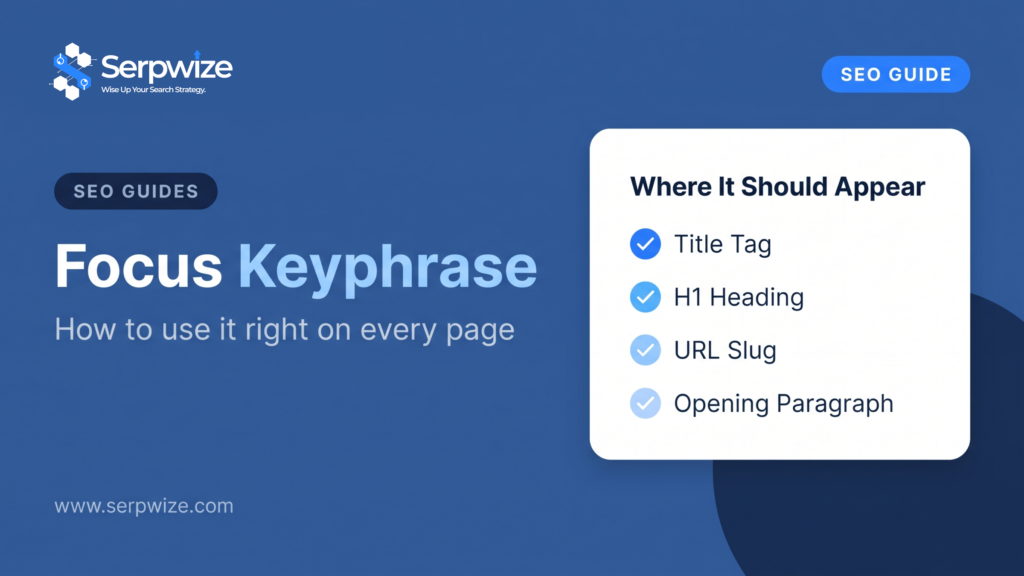
Where the focus keyphrase should appear
- SEO title: ideally near the start. See how to write an SEO title.
- H1 heading: the page’s main headline. See our guide to H1 SEO.
- URL slug: short and readable, such as
/emergency-plumber-austin/. - First paragraph: confirm early that the page answers the search.
- Meta description: Google bolds matching words in results, which helps the click.
- A subheading or two and an image alt text where it describes the image honestly. See alt text for SEO.
Everywhere else, write naturally and use related words. A page about “h1 seo” should also talk about title tags, heading structure and HTML, because that is what a complete answer covers.
What Yoast’s keyphrase checks actually test
Yoast grades a page with a list of keyphrase checks. Knowing what each one tests helps you decide which to act on and which to ignore.
| Yoast check | What it looks for | Worth acting on? |
|---|---|---|
| Keyphrase in SEO title | The phrase in the title tag | Yes, almost always |
| Keyphrase in introduction | The phrase in the first paragraph | Yes, if it reads naturally |
| Keyphrase in slug | The phrase in the URL | Yes for new pages; do not change live URLs just for this |
| Keyphrase in meta description | The phrase in the description | Yes |
| Keyphrase in subheading | The phrase or its words in H2/H3s | Where it fits |
| Keyphrase in image alt attributes | The phrase in alt text | Only where it describes the image |
| Keyphrase density | How often the phrase appears | As a warning against stuffing, not a target |
| Keyphrase length | Whether the phrase is too long | Yes; long phrases rarely match real searches |
| Previously used keyphrase | The same phrase on another page | Yes, always |
| Competing links | Links whose anchor text is the keyphrase | Yes; do not send the page’s own term to another page |
A green score does not mean a page will rank, and an orange one does not mean it will not. The checks measure placement. They cannot measure whether the page is the best answer to the search, which is what Google ranks.
Can you have more than one focus keyphrase?
In the free version of Yoast, no: one focus keyphrase per page. Yoast Premium lets you add related keyphrases and synonyms so the analysis covers variations. Rank Math accepts several focus keywords per page and treats the first as the primary one. All in One SEO adds “additional keyphrases” in its paid version.
Whatever the plugin allows, a page should still have one main search term. Related phrases are variations of the same intent (“h1 tag”, “h1 heading seo”), not different topics. If you find yourself adding a second topic, it probably needs its own page.
Common focus keyphrase mistakes
- Stuffing the phrase to turn the light green. Repeating an exact phrase in every paragraph makes the page worse to read and does not help it rank.
- Choosing a phrase nobody searches. “Best quality affordable bespoke tailoring solutions” will score well in the plugin and bring no visitors.
- Two pages, one phrase. On our own site, the tracker showed both a blog post and a service page had been set up around the same reseller term, and Google ranked the service page for it rather than the post. Each term should have one owner.
- Setting it once and never checking. Compare your focus keyphrases against Search Console every few months. Google may be showing the page for different queries than you planned, which is a signal to adjust the keyphrase or the content.
Frequently asked questions
What is a focus keyphrase?
It is the main search term a page is built to rank for, entered in an SEO plugin such as Yoast so the plugin can check how well the page uses it. Search engines do not see the field; they see the page content it guides.
What is a good focus keyphrase?
One that real people search, that matches the kind of page you are writing, that your site can realistically compete for, and that no other page on your site already targets.
What is the focus keyphrase in WordPress?
WordPress itself has no focus keyphrase. The field comes from SEO plugins: Yoast SEO and All in One SEO call it the focus keyphrase, and Rank Math calls it the focus keyword.
Does the focus keyphrase need to match the search term exactly?
Use the exact phrase in the title, H1 and URL where it reads naturally. In the body, write naturally and use related words; Google understands variations and synonyms.
Can a page have more than one focus keyphrase?
Free Yoast allows one. Yoast Premium, Rank Math and All in One SEO Pro allow additional phrases. Use the extras for variations of the same search, not for new topics.
What if my Yoast score is red but the content reads naturally?
Fix the checks that matter, such as the title, H1, URL and duplicate keyphrases, and ignore the rest. Rankings follow how well the page answers the search, not the colour of the plugin’s light.
Serpwize maps one keyphrase to one page across your whole site, so pages stop competing with each other. See our SEO outsourcing service.