
SEO copywriting is writing content that satisfies a real search intent well enough to rank, while still reading like something a human actually wanted to write and a human actually wants to read. It is not keyword density or stuffing a target phrase into every second sentence — Google’s ranking systems have moved well past that, and content written primarily to hit a keyword count rather than answer the query is exactly what modern helpful-content ranking systems are built to detect and demote.
Good SEO copywriting starts with the same research any content project needs: the real keyword, its real search volume, and most importantly its real intent. A page written for “seo copywriting services” needs to read differently than one written for “how to write SEO copy,” even though both contain the same core phrase, because one searcher wants to hire someone and the other wants to learn a skill. Writing to the wrong intent is the single most common reason a technically well-optimised page still fails to rank or convert.
What Separates SEO Copywriting From Regular Copywriting
- Written for a specific, researched keyword — not a topic in general, but the exact phrase (or close variants) real searchers use, backed by actual search volume data.
- Structured for both readers and crawlers — real H2/H3 headings that reflect actual content sections, not decorative bold text standing in for headings.
- Front-loaded with the direct answer — the most useful, citable information appears early, not after several paragraphs of scene-setting.
- Internally linked with intent — links to genuinely related pages, not link-stuffed for its own sake.
- Written to satisfy the query fully — long enough to actually answer the question, and no longer just to hit a word count.
Keyword Placement That Still Matters
Exact-match keyword stuffing is a liability now, but keyword placement is not dead — it is just narrower and more natural than it used to be. The target phrase (or a very close variant) genuinely belongs in the title tag, the H1, and at least once in the opening paragraph, because that is also where a human reader expects to see confirmation they landed on the right page. Beyond that, later mentions should read as natural language, using synonyms and related phrases rather than repeating the exact string mechanically.
Writing for Featured Snippets and AI Overviews
A growing share of SEO copywriting work now optimises for extraction, not just ranking position. Roughly 44% of AI citations come from the first 30% of a page, which means the most citable, self-contained answer needs to appear early, in a tight 40 to 60 word block that could be lifted out of context and still make sense on its own. Question-phrased subheadings that mirror how people actually search, short paragraphs, and genuine tables or lists for comparative data all improve extraction odds, on top of whatever they do for readability.
The E-E-A-T Test for Copy
Before publishing, run the copy against Google’s own three questions: who created it, how was it created, and why does it exist. Content written to hit a word count rather than genuinely help the reader fails this test even if it is grammatically perfect and keyword-accurate, and Google’s core ranking systems (which absorbed the standalone helpful-content system in the March 2024 update) are specifically tuned to catch that gap.
SEO Copywriting Checklist
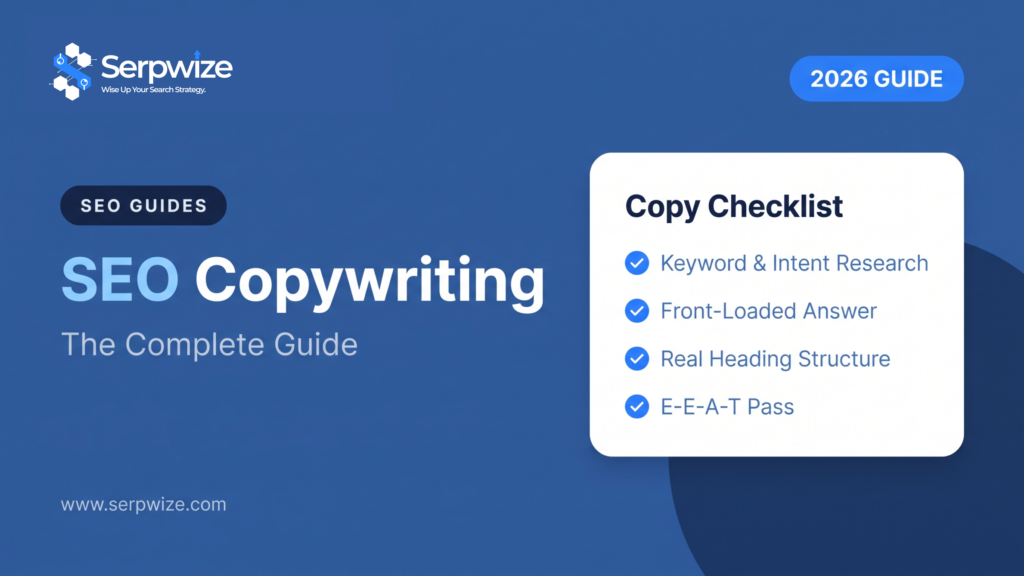
- Real keyword and intent research done before a single word is written
- Target phrase in the title, H1, and opening paragraph, natural everywhere else
- A front-loaded, self-contained answer in the first section
- Real heading tags structuring the content, not styled spans
- Internal links to genuinely related pages
- Long enough to fully answer the query, not padded to a target word count
Writing for Different Page Types
A service page, a location page, and a blog post are not the same writing task, even when they target closely related keywords. Treating them identically is a common source of both thin content and weak conversion.
Service pages need to lead with what the visitor gets and why it is different from competitors, with genuine differentiators rather than generic value propositions like “quality service” or “experienced team.” A visitor here is close to a buying decision and wants specifics: process, deliverables, and real proof.
Location pages need to read as genuinely local, not a national template with the city name swapped in. Real neighbourhood names, real local context, and content that would embarrass a competitor to copy verbatim are what separate a location page that ranks from one that reads as an obvious clone across a dozen cities.
Blog posts carry more room to teach, and that is exactly what they should do: a reader arriving from an informational search is not ready to buy yet, and copy that pushes too hard for a sale too early reads as a bait-and-switch. The conversion ask belongs at the end, once the content has actually delivered on what the reader came for.
Frequently Asked Questions
Does keyword density still matter for SEO copywriting?
Not in the way it used to. There is no ideal percentage to hit, and forcing a keyword to appear a set number of times often makes copy read worse without any ranking benefit. Natural placement in the title, H1, and opening paragraph matters far more than repeated density throughout the body.
How long should an SEO-optimised page be?
Long enough to fully answer the query and no longer. Google has directly said word count is not a ranking factor, and a 500-word page that fully answers the question beats a 2,000-word page padded with filler. Rough floors that tend to hold in practice: roughly 800 words for a service page, 500 to 600 for a location page, and 1,500 for an in-depth blog guide.
Can AI-generated content rank well?
It can, if it passes the same E-E-A-T bar as human-written content: genuine expertise, real research, and a real reason to exist beyond hitting a publishing quota. Google’s guidance is about content quality and helpfulness, not the tool used to produce it, but unedited generic AI output tends to fail the “how was it created” test specifically because it lacks real research or a distinct point of view.
Should every page target only one keyword?
One page should target one search intent, which often covers several keyword variants at once. A competitor page ranking for 50 to 100 closely related variants off a single URL is a real signal that those variants share intent and belong on one page, rather than being split into multiple thin, near-duplicate pages.
What is the biggest mistake in SEO copywriting?
Writing to satisfy an assumed word count or keyword quota rather than the actual reader’s question. This produces exactly the kind of content Google’s helpful-content-aware ranking systems are built to identify and demote, regardless of how technically correct the on-page SEO otherwise is.
Related reading: Off-Page SEO: The Complete Guide
Want content that actually ranks and actually converts? See how we approach content and off-page SEO together, or book a free strategy call to talk through your specific pages.