
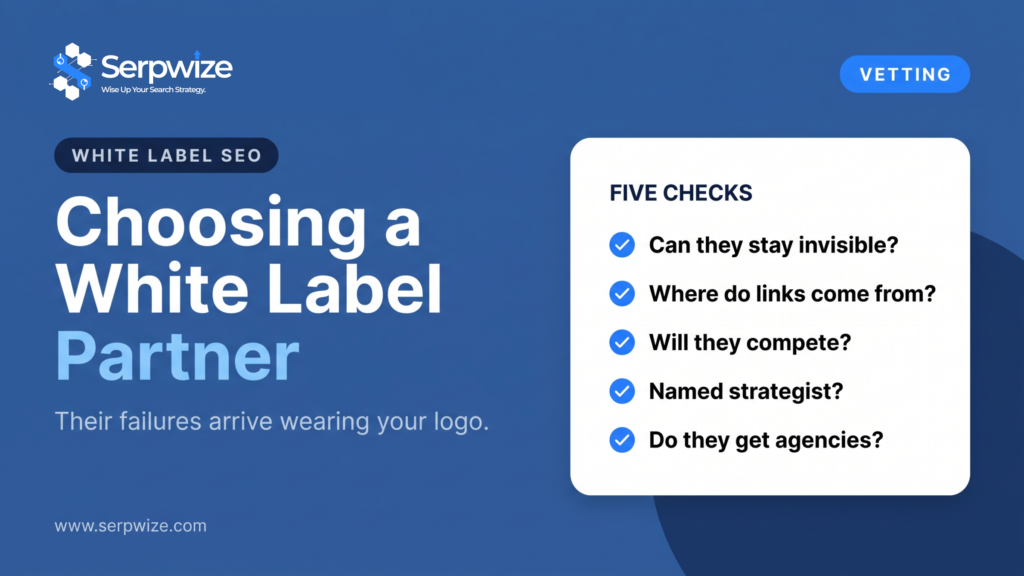
Choosing a white label SEO partner differs from choosing an agency for yourself in one decisive way: their failures arrive wearing your logo, in front of a client who pays you. The vetting has to be harder, not easier.
The five things that actually matter
1. Can they genuinely stay invisible?
Test it before you sign, not after. Ask for a sample report and audit, then check the PDF document properties, the filename convention, the email sending domain, and whether the dashboard runs on a CNAME to your subdomain. Agencies get exposed by metadata far more often than by anything anyone says on a call.
2. Where do links come from?
The highest risk in the arrangement, because damage is slow, expensive, and lands on your reputation. Ask for three live link examples from the last month. Check each: does the page load, is the link visible in editorial content, does the site have real organic traffic, and does the page also link to gambling, pharma, or crypto?
3. Will they compete with you?
Ask directly whether they sell direct in your market and to your verticals. Then get a written non-solicitation clause covering the engagement and a defined period after. A provider who resists this is telling you something.
4. Who is the named strategist, and what is the escalation path?
You need a person, not a ticket queue. Establish who runs your accounts, who you call when a client is angry on a Friday, and what the response commitment is. Client problems do not respect time zones and you are the one holding the relationship.
5. Do they understand agency economics?
A partner who has worked with agencies knows you need pre-sale support, fixed pricing across your client contract term, and volume tiers. One who has only sold direct will treat you as a client and price accordingly.
Vetting sequence
| Stage | What you do | What it reveals |
|---|---|---|
| 1. Written screen | Email the five questions above | Whether they answer directly or route around |
| 2. Sample deliverables | Request a report, audit, and link log | White label hygiene and analytical depth |
| 3. Call with the strategist | Insist the practitioner attends | Whether senior people actually touch accounts |
| 4. Paid pilot | One real client, 90 days | Everything the sales process hides |
| 5. Scale | Move accounts across gradually | Whether quality holds at volume |
Never move your whole portfolio at once. Start with one client – ideally a tolerant one, not your largest – and give it a full quarter.
Questions that expose a weak partner
- “Tell me about an engagement that went badly and what you changed.” No answer means no operating history.
- “What would you refuse to do if a client asked?” A partner with no limits will agree to things that damage your client.
- “How many agencies do you currently serve, and what is your capacity?” Capacity constraints are healthy; unlimited capacity is a warning.
- “Can I speak to an agency partner of yours?” Reluctance is informative.
- “What happens to deliverables and documentation if I leave?” You should retain everything produced and paid for.
Concentration risk
One provider delivering every client is a single point of failure for your entire service line. Once past roughly ten accounts, either keep a vetted second provider warm with one or two clients, or document your delivery process well enough to migrate inside a month. Know your switching cost before you need to switch.
Frequently asked questions
How do I choose a white label SEO partner?
Test whether they can stay invisible, verify where links come from with live examples, get a written non-solicitation clause, confirm a named strategist and escalation path, and check they understand agency economics. Then run a paid 90-day pilot on one client.
What is the biggest risk with a white label partner?
Link acquisition. Bad links damage your client’s site slowly and expensively, and because your brand is on the work, the reputational cost is yours.
Should I use more than one provider?
Past roughly ten clients, yes – or at minimum keep a vetted alternative warm. A single provider delivering your entire service line is a single point of failure.
How do I test if a provider is really white label?
Request sample deliverables and inspect PDF document properties, filenames, email sending domains, and dashboard URLs. Metadata exposes agencies far more often than conversation does.
How long should a pilot run?
Ninety days on one real client. That is long enough to judge delivery quality, communication, and whether commitments hold, without risking your portfolio.
Part of our complete guide to white label SEO.
Serpwize provides white label SEO fulfilment from India for agencies in the US, UK, and Australia. See how our reseller programme works.