
Content is usually the largest line item in an SEO budget and the easiest to get wrong. The difference between outsourced content that works and content that fills a sitemap is almost entirely in the brief.
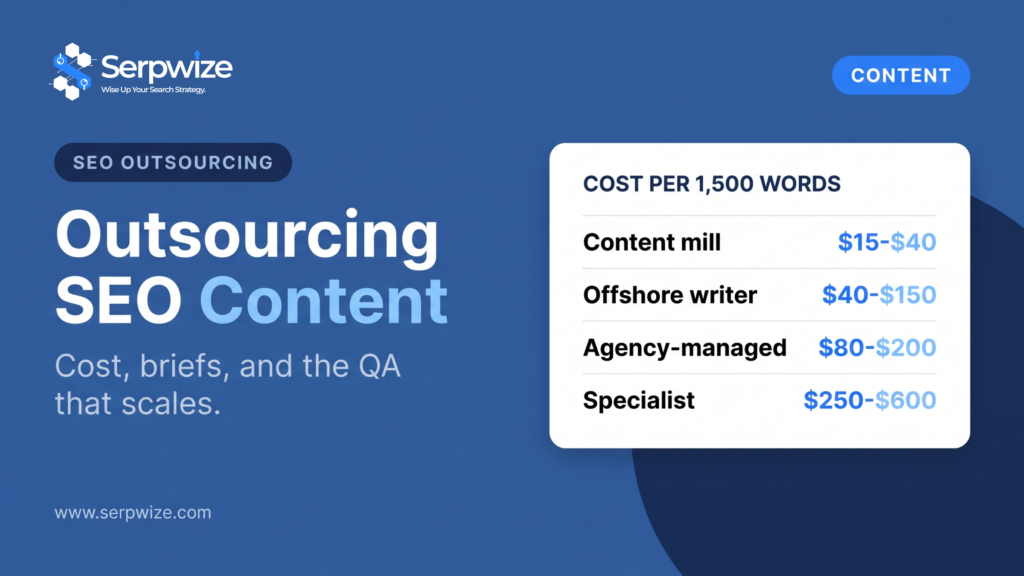
What it costs
| Source | Per 1,500 words | What you get |
|---|---|---|
| Content mill | $15-$40 | Unedited generated text. Actively harmful at volume. |
| Offshore writer (India) | $40-$150 | Researched and structured; needs a brief and an edit |
| Agency-managed (India) | $80-$200 | Briefed, written, edited, optimised |
| Western freelance specialist | $250-$700 | Subject-matter depth, minimal management |
| Subject-matter expert writer | $500-$1,500 | Genuine authority, original insight |
Most businesses over-buy at the top for informational content and under-buy at the bottom for commercial pages. Invert it: money pages deserve expensive writers, supporting content does not.
The brief is the whole job
A writer who has never met your customers cannot invent their objections. Supply that, and offshore content quality rises immediately. A usable brief contains:
- Target query and search intent — what the reader is trying to accomplish, not just the keyword
- The answer, up front — if you know the correct answer, write it in the brief. Do not make the writer guess.
- Three competing pages and what each fails to cover
- Required sections as an outline
- Proprietary inputs — your data, prices, process, customer quotes. This is what makes the piece non-generic and it can only come from you.
- Customer objections — the five things prospects say before buying
- Terminology and forbidden claims
- Internal links to include
Twenty minutes on a brief saves an hour of rewriting and produces materially better output. Most content complaints are brief failures.
The AI question, answered directly
Nearly every provider now uses AI somewhere. Pretending otherwise is not useful. What matters is where in the process it sits.
| Acceptable | Not acceptable |
|---|---|
| Research, outlining, first-draft scaffolding | Publishing generated text unedited |
| Named human rewrites, fact-checks, adds proprietary input | No named human accountable |
| Claims verified against primary sources | Statistics invented or unsourced |
| Volume matched to editorial capacity | Volume scaled because generation is cheap |
Ask directly: who edits, what do they check, and what is your policy on unverified claims. A provider who cannot answer is publishing generated text under your name.
Quality control that scales
- Approve briefs, not just drafts. Fixing direction at brief stage costs minutes; at draft stage it costs a rewrite.
- Set a five-day approval SLA on yourself. Client approval is the usual bottleneck.
- Check three things only: factual accuracy, brand voice, and whether it says anything a competitor’s page does not.
- Spot-check claims. Pick two statistics per piece and verify the source. Fabricated citations are the most common AI failure.
- Read the intro aloud. If it opens with “In today’s competitive digital landscape”, the piece is generic throughout.
What to keep in-house
- Customer objections and sales-conversation insight
- Original data, benchmarks, and case results
- Anything requiring regulated or legal review
- Founder or executive point-of-view pieces
- Final approval on commercial pages
Outsource production. Keep the parts only you can supply — which is exactly what makes content rank when everyone else’s is generic.
Frequently asked questions
How much does outsourced SEO content cost?
$40-$150 per 1,500 words from an offshore writer, $80-$200 agency-managed, and $250-$700 from a Western freelance specialist. Below $40 you are buying unedited generated text.
How do I get good content from an offshore writer?
Supply a real brief: target intent, the answer if you know it, three competitor pages and their gaps, your proprietary data, and the five objections customers raise. Most quality complaints are brief failures.
Is it acceptable for an agency to use AI?
For research, outlining, and first drafts, yes. Publishing unedited generated text is not. Ask who edits, what they verify, and what the policy is on unsourced claims.
What should I check in a draft?
Factual accuracy, brand voice, and whether it says anything competitors’ pages do not. Verify two statistics per piece — fabricated citations are the most common failure.
What should I never outsource?
Customer objections, original data, regulated content, and executive point-of-view pieces. Those are what differentiate the content, and they can only come from you.
Part of our complete guide to SEO outsourcing.
Serpwize runs outsourced SEO from India for businesses and agencies in the US, UK, and Australia. See how our engagements are structured.