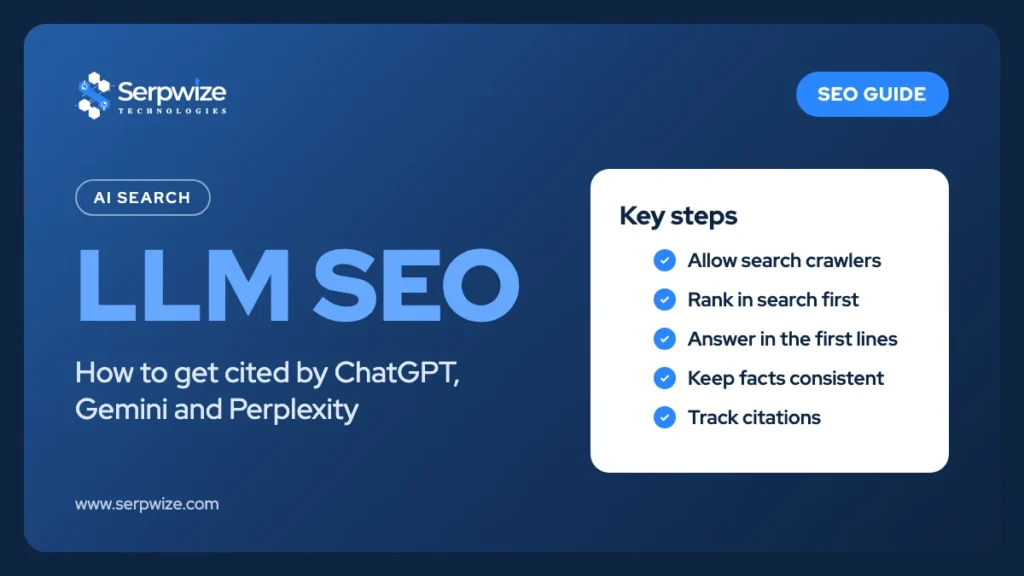
Short answer: LLM SEO is the work of getting your brand mentioned, recommended and cited when people ask large language model assistants such as ChatGPT, Gemini, Perplexity, Claude and Google’s AI Overviews a question. It builds on ordinary SEO rather than replacing it: most assistants that cite sources pull them from live search results, so the pages that rank, answer the question directly and are backed by consistent facts across the web are the pages that get quoted.
What is LLM SEO?
LLM SEO, also called LLM optimization, means shaping your website and your wider online presence so that large language models describe your business accurately and choose your pages as sources. In the US, “llm seo” and “llm optimization” were each searched about 720 times a month between October 2025 and September 2026 (Google Ads data via DataForSEO), a sign that marketers are trying to work out what changes when the answer comes from a model rather than a list of links.
Two things decide whether an assistant mentions you. The first is what the model learned in training, which you cannot edit directly. The second, and the one you can influence, is what the assistant retrieves at the moment of the question: when ChatGPT search, Perplexity or Google AI Overviews look something up, they read current web pages and cite some of them.
LLM SEO vs traditional SEO vs GEO
| Traditional SEO | LLM SEO | GEO | |
|---|---|---|---|
| Goal | Rank pages in search results | Be named and cited by AI assistants | Be cited in generative answers, including AI search features |
| Main surfaces | Google and Bing results pages | ChatGPT, Gemini, Claude, Perplexity, Copilot | Google AI Overviews and AI Mode, plus the assistants |
| Success measure | Rankings, clicks, conversions | Mentions, citations, referral visits | Citations and visibility in AI answers |
| Foundation | Crawlable, relevant, linked pages | The same, plus consistent facts and clear answers | The same |
In practice the three overlap so much that most teams treat LLM SEO and generative engine optimization (GEO) as one workstream on top of good SEO.
How AI assistants choose which sources to cite
When an assistant searches the web before answering, it behaves like a fast, picky reader. It runs one or more searches, reads the top results, and quotes the passages that answer the question most directly. Google says there is nothing special required to appear in its AI features beyond following its normal Search guidance (Google Search Central: AI features and your website). That matches what we see: pages that already rank and answer the question in the first lines are cited far more often than pages that bury the answer.
On our own client work, a roofing contractor whose cost and storm-insurance guides were rebuilt answer-first went from untracked AI visibility to 121 AI citations in June 2026, up 152% on January. The roofing case study has the detail.
How to optimize for LLMs: 8 steps
1. Let the right crawlers in
Check robots.txt and your firewall or CDN. AI search features can only cite pages their crawlers are allowed to fetch.
| Crawler | Company | Used for |
|---|---|---|
| OAI-SearchBot | OpenAI | Showing sites in ChatGPT search results |
| GPTBot | OpenAI | Collecting content for model training |
| PerplexityBot | Perplexity | Indexing pages for Perplexity answers |
| Google-Extended | Controls use of your content for Gemini models; it does not affect Google Search rankings | |
| Bingbot | Microsoft | Bing search, which Copilot draws on |
You can block training crawlers and still allow search crawlers. Blocking search crawlers usually means the assistant cannot cite you at all.
2. Rank in ordinary search first
Assistants that browse mostly read what search engines already rank. A page on page five of Google is rarely the one ChatGPT quotes. Fix crawling, indexing and relevance before anything AI-specific; our technical SEO services page lists what that involves.
3. Put the answer in the first lines
Open each page, and each section, with a direct two or three sentence answer, then explain. Use question-style headings that match how people ask. Models lift self-contained passages; a definition that needs the paragraph above it to make sense is harder to quote.
4. Keep your facts consistent everywhere
Your company name, services, locations and key facts should read the same on your site, Google Business Profile, LinkedIn, directories and review sites. When sources disagree, models hedge or pick the wrong version.
5. Publish things only you can say
Original data, real project results, specific prices or timelines from your own work and named expert opinions give a model a reason to cite you rather than the ten other pages saying the same thing.
6. Earn mentions on other sites
Assistants often build recommendations from lists, reviews, forums and news coverage. Being named on credible third-party pages matters as much as your own content.
7. Add structured data that matches the page
Organization, Service, Product, Article and FAQ markup help search engines understand who you are and what a page covers. It must describe what is visible on the page.
8. Track mentions and citations
Run a fixed set of real buyer questions through the main assistants each month and record whether you are mentioned, which page is cited and which competitors appear instead.
What does not work
- Mass-producing AI-written pages. Thin, near-identical pages are the kind Google’s systems filter out, and filtered pages are not retrieved by the assistants that rely on search.
- Treating llms.txt as a ranking lever. It is a proposed file for guiding language models to your key content. It is harmless to add, but do not expect it to replace rankings, clear answers or mentions.
- Writing for the bot instead of the reader. Keyword-stuffed question lists read badly and give a model nothing worth quoting.
How to measure LLM visibility
- Referral traffic: in GA4, look for sessions from chatgpt.com, perplexity.ai, gemini.google.com and copilot.microsoft.com.
- Prompt tracking: a monthly log of 20 to 50 real questions your buyers ask, showing who gets mentioned and cited.
- Cited pages: which of your URLs are quoted, so you can strengthen them and fix the ones that are not.
- Search Console: AI Overview impressions and clicks are counted in normal Search Console totals, so watch the pages and queries that also appear in AI answers.
Frequently asked questions
What is LLM SEO?
LLM SEO is optimizing your website and online presence so large language model assistants such as ChatGPT, Gemini, Claude and Perplexity mention your brand accurately and cite your pages when they answer questions.
Is LLM SEO different from GEO?
Only slightly. GEO, generative engine optimization, usually refers to AI answers in search engines such as Google AI Overviews, while LLM SEO is often used for standalone assistants. The methods are almost the same.
Does LLM SEO replace traditional SEO?
No. Assistants that cite sources mostly draw on pages that already rank in search, so traditional SEO is the foundation and LLM SEO adds clear answers, consistent facts and citation tracking on top.
Should I block AI crawlers?
Block training crawlers if you do not want your content used to train models, but allow search crawlers such as OAI-SearchBot and PerplexityBot if you want to be cited in AI answers.
How long does it take to appear in ChatGPT answers?
For answers that use live search, it can follow soon after your page ranks and is crawled. Changing what a model says from its training data takes much longer and depends on the next model update.
Serpwize tracks AI mentions and citations for clients and fixes the pages assistants quote. See our AI SEO and GEO services.