
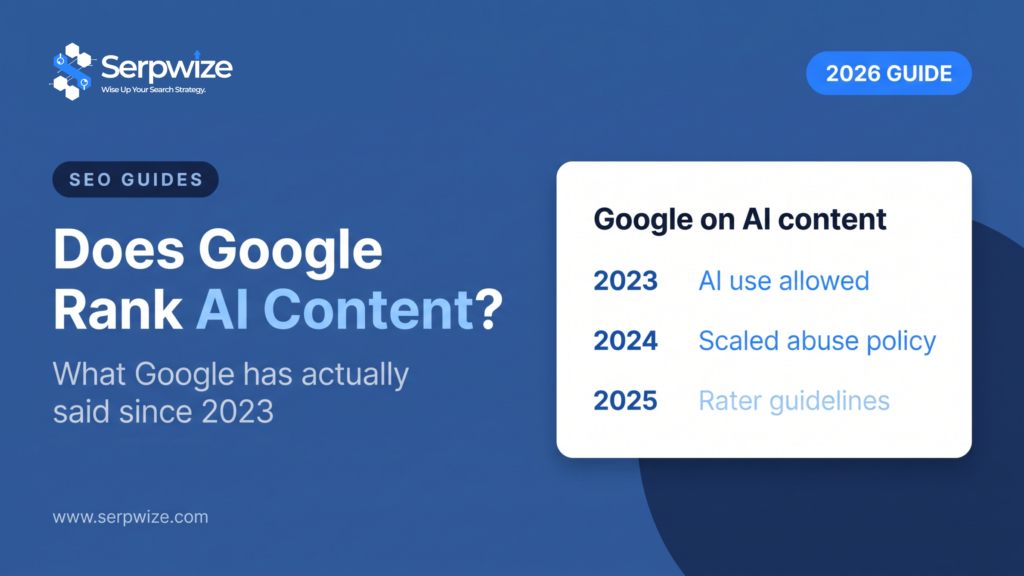
Yes, Google ranks AI content. Google does not penalize a page because AI helped write it, and it does not reward a page for that either. What Google acts against is content made mainly to manipulate rankings, especially large numbers of pages that add little value, and that applies whether a person, an AI tool or both produced them. The rest of this guide shows exactly where that position comes from, how it has tightened since 2023, and what it means for a business publishing AI-assisted content today.
Every quotation and date below was checked against Google’s own pages on 1 October 2026. The search data was pulled the same day.
What Google Has Actually Said, in Order
Most articles on this topic quote one Google post from 2023 and stop. Google’s position has developed since then, and the later documents matter more for anyone publishing at volume.
| Date | Source | What it established |
|---|---|---|
| 8 February 2023 | Google Search Central blog: guidance about AI-generated content | “Appropriate use of AI or automation is not against our guidelines.” AI content gets no special treatment in either direction. |
| 5 March 2024 | March 2024 core update and new spam policies | Introduced the scaled content abuse policy, covering mass-produced low-value pages whether made by automation, people or a mix. |
| April 2024 | Google statement after the update finished on 19 April | Google said results showed 45% less low-quality, unoriginal content, against the 40% it had expected. |
| January 2025 | Search Quality Rater Guidelines update | Section 4.6.6 tells raters to give the Lowest rating to main content that is copied, auto-generated or AI-generated with little effort, originality or added value. |
| Last updated 10 December 2025 | Google’s guidance on using generative AI content on your website | Generative AI is useful for research and structure, but generating many pages without adding value may break the scaled content abuse policy. Metadata, structured data and alt text must be accurate too. |
Read in order, the direction is clear. Google never banned AI content, but it has steadily sharpened the tools it uses against low-value content produced at scale, which is exactly what careless AI use tends to produce.
The Two Sentences That Answer the Question
Google’s 2023 guidance answers “will AI content rank highly?” plainly: “Using AI doesn’t give content any special gains. It’s just content.” If it is useful, helpful and original and shows experience and expertise, it may do well. If it does not, it may not.
The 2024 spam policy supplies the other half. Scaled content abuse is defined by purpose and value, not by method: many pages made primarily to manipulate rankings, with little value to users, “no matter how it’s created.” Put together, the tool is irrelevant and the output is everything.
Common Beliefs, Checked Against Google’s Documents
- “Google penalizes AI content.” Not as such. Google states that appropriate use of AI is not against its guidelines. Pages are demoted for being unhelpful or manipulative, not for being AI-assisted.
- “Human-written content is automatically safe.” No. The scaled content abuse policy explicitly covers content made by human effort as well as automation. A team of writers churning out near-identical pages is in the same position as a script doing it.
- “The rater guidelines prove Google demotes AI.” The guidelines tell human raters how to judge quality, and Google says their ratings do not directly influence ranking. They show what Google’s systems are trying to reward, which is useful, but they are not a list of ranking factors.
- “You must hide that you used AI.” Google suggests the opposite where it makes sense: giving readers context on how content was produced, and accurate author bylines wherever someone would reasonably ask who wrote it.
- “Google runs an AI detector over every page.” Google has not said it ranks pages by detecting AI. Its published policies judge value, originality and scale. Google does watermark output from its own Gemini models with SynthID, but it has not said that watermark is used in ranking.
What Independent Studies Found
Two large studies point the same way. Semrush’s April 2026 study combined a survey, in which 72% of SEOs said AI content ranks at least as well as human-written content, with an analysis of 42,000 blog pages that found position-one results were more likely to be human-written. Ahrefs, in July 2025, concluded that Google neither punishes nor rewards AI content as a category. The reasonable reading of both: AI-assisted pages can and do rank, but the very top positions still go mostly to content with clear human input, which fits Google’s emphasis on experience and originality.
Where AI Content Actually Gets Into Trouble
Scale without difference
The fastest way to fall foul of the scaled content abuse policy is to generate dozens of pages that differ only by a city, a product or a keyword. Each page may read fine on its own. Side by side, they say the same things in the same order. Before we publish any group of related pages, we compare them for repeated six-word phrases and rewrite anything that overlaps heavily, because a reader comparing two pages is exactly what a quality system does at scale.
Confident errors
AI tools state invented numbers, outdated rules and misremembered dates in the same fluent tone as facts. Our rule is that every statistic and every comparative claim, such as “the highest” or “the only”, is checked against its original source before publishing. On a recent service page draft, that check caught four claims the underlying data did not support, each of which read perfectly naturally.
Nothing first-hand
An AI model can summarize what is already on the web. It cannot run your test, quote your client data, photograph your work or describe what happened on your project. Pages that rank near the top usually contain something only the publisher could have written. Add it deliberately: your data, your process, your examples, your judgement.
Careless metadata and markup
Google’s guidance names titles, meta descriptions, structured data and image alt text specifically. Auto-generated metadata that misdescribes a page, or schema that claims content the page does not show, causes problems even when the body text is good. Ecommerce sites face an extra rule: Google Merchant Center requires AI-generated product images to carry IPTC metadata marking them as AI-generated, and AI-generated product titles and descriptions to be labelled as such.
What People Are Searching
| Search term (US) | Monthly searches |
|---|---|
| does google penalize ai content | 90 |
| ai generated content seo | 70 |
| is ai content bad for seo | 50 |
| google ai content policy | 40 |
| can google detect ai content | 30 |
| does ai content rank in google | 30 |
| does google rank ai content | 10 |
Source: Google Ads keyword data via DataForSEO, monthly averages for September 2025 to August 2026, pulled 1 October 2026.
The worry is growing rather than fading. “Is ai content bad for seo” sat at 10 searches a month in January and February 2026, then reached 170 in July 2026 and 140 in August. The question has moved from “can I use AI?” to “is the AI content I already published hurting me?”
A Practical Standard for AI-Assisted Content
- Use AI for the first draft and the structure, not for facts. Supply the source material yourself.
- Verify every number against its original source and record where it came from on the page.
- Add something only you can provide: data, examples, photographs, quotes or a clear expert view.
- Compare related pages against each other before publishing a batch, and rewrite repeated passages.
- Check the metadata and schema by hand, and validate structured data before it goes live.
- Put a real, named author on the page where readers would expect one, with an author page that shows their experience.
- Review older AI-assisted pages that get no impressions in Search Console, and improve, merge or remove them.
For using AI tools well in the first place, see our guide to SEO optimization with ChatGPT, and for the writing itself, our SEO copywriting guide.
Frequently Asked Questions
Does Google penalize AI-generated content?
No, not because it is AI-generated. Google’s guidance states that appropriate use of AI or automation is not against its guidelines. Content is demoted when it is unhelpful, unoriginal or produced mainly to manipulate rankings, which can apply to human-written content too.
Can AI content rank on the first page of Google?
Yes. AI-assisted pages rank across many searches. Studies suggest the very top positions more often go to content with clear human input, so the best results come from AI drafts improved with original data, examples and expert editing.
Can Google detect AI content?
Google has not said it ranks pages by detecting whether AI wrote them. Its published policies focus on value, originality and scale. Whether or not a page could be identified as AI-written, the question that decides its ranking is whether it helps the reader.
Should I disclose that I used AI to write content?
Google suggests giving readers context on how content was created where they would reasonably want it, and using accurate author bylines. Ecommerce sites using Google Merchant Center must label AI-generated product images and product text.
Is it safe to publish lots of AI pages at once?
It is the riskiest way to use AI. Google’s scaled content abuse policy targets many pages made mainly to manipulate rankings with little value. If you publish in volume, make sure each page has genuinely different information, and compare pages against each other before they go live.
Related reading: AI Search Visibility Challenges for SEO Teams and Will AI Replace Outsourced SEO?
Not sure whether your existing AI-assisted pages are helping or hurting? Talk to us about our AI SEO and GEO services.