
Competitor keyword analysis is the process of finding the search terms your competitors rank for, comparing them with your own rankings, and deciding which of the gaps are worth closing. Done well, it ends with a short, ranked list of pages to create or improve. Done badly, it ends with a spreadsheet of 20,000 keywords that nobody opens again.
About 1,300 people a month search for “competitor keyword analysis” in the United States, according to Google Ads data retrieved through DataForSEO on 3 October 2026. This guide shows the method we use at Serpwize, then runs it on that very keyword so you can see what the output looks like with real numbers.
What Competitor Keyword Analysis Can and Cannot Tell You
It can show you topics your market searches for that your site does not cover, pages where a rival outranks you on a term you already target, and the type of page Google prefers for each query. It is the fastest way to find content you are missing, because someone else has already tested the demand.
It cannot tell you exactly how much traffic a competitor gets. Every third-party tool estimates rankings from its own crawls and keyword database. Google says plainly in its guidance on hiring an SEO that such tools have no access to its internal ranking data. Treat the numbers as direction, not fact, and check anything important against a live search.
A Worked Example: We Ran the Method on This Keyword
Before rewriting this article, we analysed the keyword it targets. Three findings changed how we wrote it.
Finding 1: Three phrasings are one keyword
“Competitor keyword analysis”, “competitor keyword research” and “keyword competitor analysis” returned identical figures for every month of the year. Identical monthly numbers are a strong sign that Google Ads groups the phrasings together, so they belong on one page, not three.
| Search term (US) | Monthly searches | Avg. ad click | Difficulty (0–100) |
|---|---|---|---|
| competitor keyword analysis | 1,300 | $30.23 | 25 |
| competitor keyword research | 1,300 | $30.23 | 14 |
| competitor keywords | 590 | $14.11 | 19 |
| find competitor keywords | 480 | $23.90 | 37 |
| competitive keyword analysis | 390 | $9.17 | 24 |
| how to find competitor keywords | 320 | $20.92 | 19 |
| competitor keyword research tool | 320 | $18.96 | 77 |
| keyword gap analysis | 90 | $14.06 | 20 |
Twelve-month averages, September 2025 to August 2026. Difficulty is DataForSEO’s keyword difficulty score.
The averages hide a lot of movement. The main term peaked at 4,400 searches in September 2025 and fell to 260 in August 2026. If you plan content from one month of data, you can be badly wrong in either direction.
Finding 2: Your search competitors are not your business competitors
We asked which domains rank most often across this group of keywords. The top of the list is software companies, not agencies:
| Domain | “competitor keyword analysis” | “competitor keywords” | “competitive keyword analysis” |
|---|---|---|---|
| spyfu.com | 1 | 1 | 1 |
| mangools.com | 2 | 4 | 3 |
| semrush.com | 3 | 3 | 2 |
| seranking.com | 6 | 7 | 5 |
| ahrefs.com | 14 | 31 | 29 |
Positions from the DataForSEO Labs keyword database, United States, retrieved 3 October 2026.
An SEO agency that only watched other agencies would miss that its real rivals for this topic are tool vendors with very strong domains. That matters for prioritising: the tool companies win the commercial “tool” queries (difficulty 77 for “competitor keyword research tool”), while the how-to queries sit around difficulty 14 to 25 and are far more open.
Finding 3: The live results did not match the database
When we checked Google live on the same day, the first page looked different. A Reddit thread in r/SEO held first place, followed by a StoryChief article, an SEO Bot guide, a LinkedIn post, a Digital Engage article, an n8n workflow template, a second Reddit thread, a Quora question and a Medium post. An AI Overview sat above them, citing eight sources including Semrush, SpyFu, SE Ranking, Rank Math, GR0 and a YouTube video.
Keyword databases refresh on their own schedule, and Google tests different results constantly. Forums and social posts on page one usually mean Google has not found a page that answers the question well, which is exactly the opening a thorough guide can take. You only see that by looking at the live results yourself.
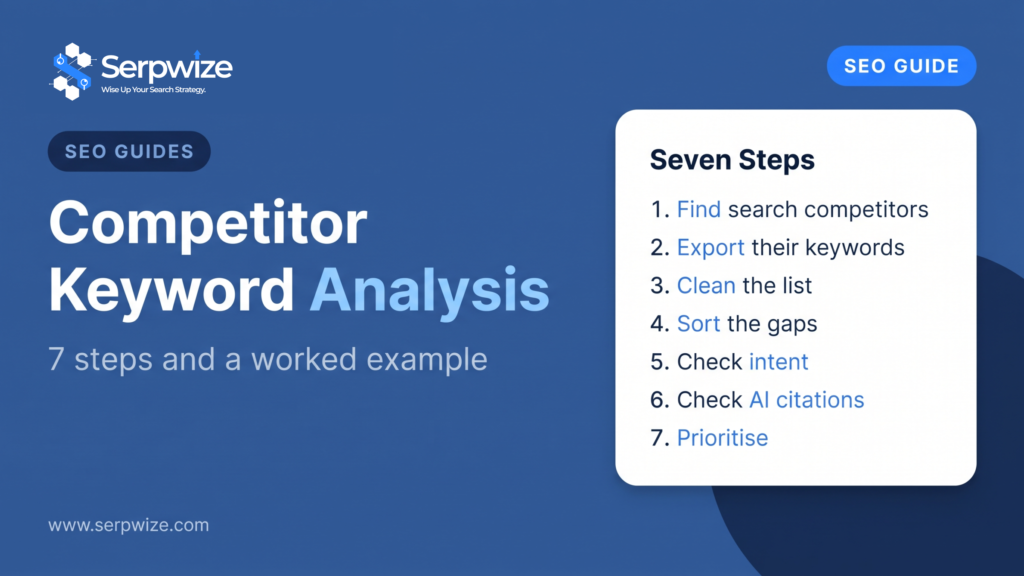
How to Do a Competitor Keyword Analysis in Seven Steps
1. Find your search competitors
Search your ten most important keywords and note every domain on page one. The sites that appear most often are your search competitors, whether or not you have heard of them. A SERP competitor report in Semrush, Ahrefs or DataForSEO does the same thing at scale. Leave out platforms you cannot realistically replace, such as Reddit, YouTube and Wikipedia, but note when they appear, because they tell you what format searchers want.
2. Export the keywords each competitor ranks for
For each of three to five competitors, export their ranking keywords with position, monthly searches and the URL that ranks. Export by page as well as by domain: one strong competitor article often ranks for dozens of variants, which shows you how much a single page can cover. Google’s free Keyword Planner can also suggest keywords from a competitor’s URL, though without ranking positions.
3. Clean the list
Remove the competitor’s brand terms and anything unrelated to what you sell. Merge phrasings that share identical monthly data, as in Finding 1. Most raw exports shrink by more than half at this stage, and that is the point.
4. Sort the gaps into three groups
- Missing: the competitor ranks, you do not rank at all. Usually a new page.
- Weak: you rank, but well behind them, often between positions 11 and 30. Usually an existing page to improve.
- Shared and close: you both rank on page one. Usually small on-page work or internal links.
Semrush’s Keyword Gap tool labels these groups for you. In a spreadsheet, a lookup between your export and theirs does the same job.
5. Check the intent behind each keyword
Search the keyword and look at what ranks. If page one is full of software home pages, a blog post will struggle. If it is full of guides and forum threads, a better guide can win. Finding 2 shows why this step matters: the same topic split into tool queries and how-to queries with very different chances.
6. Check who AI search cites
In 2026 a competitor can win a query without the top organic spot, by being cited in Google’s AI Overview or in ChatGPT and Perplexity answers. Note which domains are cited for your priority keywords. Pages that are cited tend to define the term early, use clear headings and include specific data. If you want to be cited too, our guide to SEO optimization with ChatGPT covers how.
7. Prioritise and assign each gap to a page
Score each remaining keyword on three things: how closely it matches what you sell, how much demand it has, and how realistic it is to win given the difficulty score and the sites already ranking. Then decide which page owns it. Check first whether you already have a page on the topic. We did that before writing this article, found an older, thinner version at this address, and rebuilt it rather than publishing a second page that would compete with the first.
Free and Paid Tools for Competitor Keyword Analysis
| Tool | Cost | Best used for |
|---|---|---|
| Google search, checked by hand | Free | Seeing the live results, intent and AI Overview citations |
| Google Keyword Planner | Free with a Google Ads account | Keyword ideas from a competitor’s URL, without rankings |
| Google Search Console | Free | Your own real queries and positions, to compare against competitor exports |
| Semrush | Paid | Organic research per domain and the Keyword Gap comparison |
| Ahrefs | Paid | Organic keywords per page and competitor comparison reports |
| SpyFu | Paid, limited free searches | Competitor keyword history, including paid search |
| SE Ranking and Mangools | Paid | Lower-cost alternatives for smaller sites |
| DataForSEO | Paid API, pay as you go | Pulling raw data into your own spreadsheets or scripts, as in the example above |
Is there a free way to do it? Yes, for small sites: list your competitors from manual searches, use Keyword Planner on their URLs, and compare the ideas against your own Search Console queries. You lose ranking positions and scale, but the decisions you make in steps 5 to 7 are the same.
Mistakes That Waste the Analysis
- Studying business rivals only. A competitor with no organic visibility has nothing to teach you about search.
- Chasing volume. A 5,000-search keyword that does not match your service brings visitors who leave.
- Splitting one keyword across several pages. Variants that share data belong on one page, or your own pages compete with each other.
- Trusting one month of data. As the example shows, monthly figures can swing by more than ten times.
- Skipping the live search. The database said software companies; the live page said forums. Both were true on the same day.
Frequently Asked Questions
What is competitor keyword analysis?
It is the process of identifying the keywords your search competitors rank for, comparing them with your own rankings, and choosing which gaps to close with new or improved pages. The output should be a prioritised list of pages, not a raw keyword export.
Is there a free tool for competitor keyword analysis?
Google Keyword Planner can suggest keywords from any competitor URL at no cost, and Google Search Console shows your own rankings. Together with manual searches, they cover the basics for a small site. Paid tools such as Semrush, Ahrefs and SpyFu add ranking positions and side-by-side gap reports.
How many competitors should I analyse?
Three to five search competitors is enough for most sites. Beyond that, the extra keywords mostly repeat what you have already found.
What is the difference between competitor keyword analysis and keyword gap analysis?
Keyword gap analysis is one step inside competitor keyword analysis: the comparison that shows which keywords a competitor ranks for and you do not. The full analysis also covers choosing the right competitors, cleaning the data, checking intent and deciding which page should target each keyword.
How accurate are competitor keyword tools?
They are estimates. Each tool builds its own keyword database and checks rankings on its own schedule, so two tools can disagree, and neither may match what you see in a live search. Use them to find opportunities, then confirm the important ones by searching yourself.
How often should I repeat a competitor keyword analysis?
Every three months suits most businesses, and monthly in fast-moving markets. Re-run it straight away if a new competitor appears on page one for your main terms or your traffic drops without an obvious cause.
Want this done for your site? Competitor keyword analysis is part of the free audit behind our professional SEO services.