
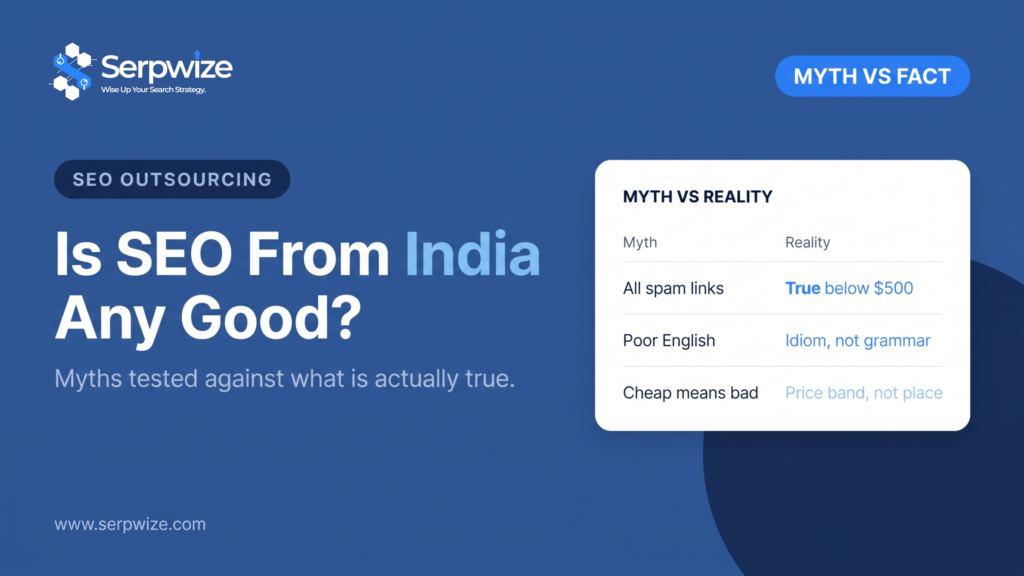
Short answer: yes, at the right price band. India produces some of the best SEO work in the world and some of the worst, and the difference is almost entirely explained by what you pay and how you vet. The reputation problem comes from the bottom of the market being unusually visible and unusually cheap.
This page separates the myths from what is genuinely true, so you can judge a specific provider rather than a country.
Where the bad reputation came from
In the 2000s and early 2010s, India became the global centre for cheap link building. When directory submissions, article spinning, and comment links still worked, thousands of Indian shops sold them as cheap monthly packages, and Western businesses bought at volume. Penguin in 2012 destroyed that model and left a large population of penalised sites whose owners could accurately say "I outsourced SEO to India and got penalised."
What they had actually bought was the cheapest possible SEO from anywhere. The same tactics were sold from Florida and Manchester at the same time. India got the association because it had the most volume at the lowest price.
That legacy still shapes perception more than current reality does.
Myths versus reality
| Claim | Verdict | Detail |
|---|---|---|
| "Indian SEO is all spam links" | Myth | True of the bargain-basement packages, which still exist. Not true of established agencies, where outreach-based acquisition is standard. |
| "The English will not be good enough" | Mostly myth | Grammar is rarely the issue. Idiom and regional vocabulary can be, and an editing pass fixes it. |
| "They will not understand my market" | Partly true | Real for hyper-local content. Manageable with a proper brief. Most Indian teams work on US and UK sites daily. |
| "Time zones make it unworkable" | Myth | A two-hour daily overlap is enough. Overnight turnaround is frequently an advantage. |
| "Cheap means low quality" | True at the bottom, false in the middle | The cheapest packages buy nothing anywhere. Mid-market Indian agencies buy senior talent: 76% of India-based providers in Ahrefs’ survey of 439 SEO providers charge $1,000 a month or less, while 79.1% of US and Canadian providers charge $1,001 or more. |
| "They just use AI now" | True of some, everywhere | Unedited AI output is a global problem, not an Indian one. The question is whether a named human edits and fact-checks. |
| "You cannot get senior people" | Myth | India has one of the world’s largest populations of 10-15 year SEO veterans, precisely because the industry is old there. |
What India is genuinely good at
- Technical SEO at scale. Large-site crawling, indexation management, schema implementation, and log-file work. The engineering talent pool is deep and the work is objective enough to verify easily.
- Content volume with consistent process. Producing eight well-structured pieces a month reliably, month after month, is an operational strength.
- Programmatic and template-driven SEO. Building hundreds of location or category pages with clean architecture is a natural fit for the available skill mix.
- Long-running maintenance. The economics support sustaining a programme for years rather than a burst of activity.
Where India is genuinely weaker
- Digital PR into Western press. Placing stories with US or UK journalists benefits from being in that media ecosystem. Indian teams can execute outreach, but relationship-led placement is harder remotely.
- Hyper-local content. Writing convincingly about a specific American suburb’s character requires either living there or a very good brief.
- Highly regulated copy. Medical, legal, and financial content needing jurisdiction-specific compliance review usually needs a local reviewer in the loop.
- Brand voice for consumer lifestyle brands. Where tone is the product, calibration takes longer.
How to tell a good Indian agency from a bad one in ten minutes
Signals of a good one:
- They ask about your business model and margins before quoting
- They put the actual strategist on the call, not only a salesperson
- They decline to guarantee rankings
- They can describe an engagement that went badly and what they changed
- Their proposal decomposes into hours by seniority
- They ask who will approve content on your side
Signals of a bad one:
- A price quoted before anyone looked at your site
- A monthly link quota in the proposal
- "Guaranteed first page" in any form
- Packages named Silver, Gold, Platinum with no scope detail
- Reporting samples that show only rankings and impressions
- Reluctance to name who does the work
Is it a good idea to hire an Indian SEO company for a US website?
Yes, if the team already works mainly on US sites and you give it a clear brief. Most established Indian agencies optimise for Google.com every day, so the search side is familiar. What needs checking is US-specific: American spelling and terms, an understanding of how your buyers search, and enough overlap with US hours for the calls you genuinely need.
- Ask for US work: live pages they wrote or optimised for US clients, not only case-study slides.
- Agree the overlap: a fixed early-morning US window covers most calls; everything else runs overnight.
- Write a glossary: product terms, regional vocabulary and competitors, so first drafts are close rather than generic.
- Contract in a currency you control and keep ownership of every account in your name.
Do Indian SEO agencies have high staff turnover?
People move between employers often in India’s digital services market, so continuity has to be built into the engagement rather than assumed. The risk is not that someone leaves; it is that knowledge about your site leaves with them.
- Name the lead in the contract, with a clause that any replacement is introduced and briefed before taking over.
- Require a written change log of every change made to your site, so its history does not live in one person’s head.
- Keep strategy documents in shared folders you own, not in the provider’s private drive.
- Ask how many people have run your type of account in the last year. A straight answer tells you more than a promise.
Our guide to SEO outsourcing contracts and SLAs covers the named-team clause in detail.
How to spot an SEO outsourcing scam
Most SEO scams arrive the same way: an unsolicited email saying your site has errors or is "not ranking on Google", sent from a free email address, offering first-page results for a small monthly fee. Genuine agencies rarely cold-email with guarantees.
Warning signs:
- Guaranteed first-page or number-one rankings, in any wording
- A sender using a Gmail, Outlook or similar free address rather than a company domain
- A fixed number of links per month at a price no real outreach could support
- Pressure to pay several months upfront, or to pay by an untraceable method
- No named people, no business address and no website showing real work
- Requests for hosting or admin passwords before any contract exists
To check an Indian company is real, ask for its registration details. A private limited company or LLP has a CIN or LLPIN you can look up on the Ministry of Corporate Affairs portal, and a GST-registered business has a GSTIN you can check on the official GST portal. Then speak to the named strategist on a video call before paying anything. Our own registration details are listed on our SEO outsourcing page.
Frequently asked questions
Is SEO from India any good?
Yes, at the right level. India has one of the deepest senior SEO talent pools in the world. It also has the world’s largest supply of bargain packages, and those are what created the reputation problem. Quality tracks price band and vetting, not geography.
Why does Indian SEO have a bad reputation?
Because India dominated the cheap link-building market before the 2012 Penguin update, and a large number of Western businesses were penalised after buying the cheapest available service. The same tactics were sold everywhere; India simply had the most volume.
Can an Indian team write for a US or UK audience?
Yes, with a brief and an editing pass. Grammar is rarely the problem. Regional idiom and vocabulary need calibration, typically over the first two months.
What should I pay to get good SEO from India?
In Ahrefs’ survey of 439 SEO providers, 76% of India-based providers charged $1,000 a month or less. Published Indian prices on 27 October 2026 ran from $250 a month (SEO Discovery) to $3,100 (iMark Infotech). The bottom of that range does not support senior involvement; see our guide to the cost of outsourcing SEO to India.
Should I worry about my data or site access?
Use the same controls you would with any vendor: you own all accounts, grant delegated access only, and revoke on exit. Geography does not change the correct practice.
Is it a good idea to hire an Indian SEO company for a US site?
Yes, if the team works mainly on US sites, you agree a fixed overlap window and you supply a glossary of your terms. Ask for live US pages they have worked on before signing.
How do I avoid problems from staff turnover?
Name the lead in the contract, require a written change log of every site change, and keep strategy documents in folders you own, so a change of person does not mean a loss of knowledge.
How can I check an Indian SEO company is legitimate?
Ask for its CIN or LLPIN and GSTIN, look them up on the Ministry of Corporate Affairs and GST portals, and speak to the named strategist on video before paying. Be wary of unsolicited emails promising guaranteed rankings.
The honest summary
"Is SEO from India good?" is the wrong question, in the same way "are American agencies good?" would be. India contains the full quality range, with more volume at the cheap end than anywhere else, which skews perception.
Judge the provider: named strategist, hours decomposed by seniority, explicit link policy, no ranking guarantees, and a real answer about what happens in month one. Those five answers tell you far more than the country on the invoice.
This article is part of our complete guide to SEO outsourcing. See also why outsource to India and how to choose a partner.
Serpwize runs outsourced SEO from India for businesses and agencies in the US, UK, and Australia. See how our engagements are structured.