
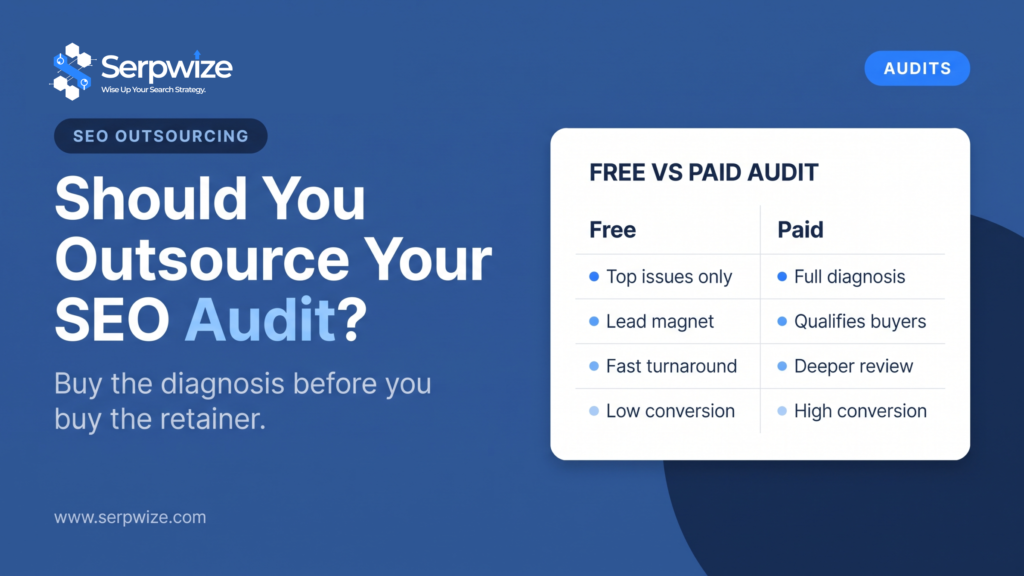
Yes — and buy it before you buy anything else. A paid audit is the cheapest way to find out how a provider thinks, and it is the only SEO deliverable that is genuinely useful even if you never work with that provider again.
Why the audit comes first
- It is a work sample. $400-$2,500 buys you evidence of judgement, prioritisation, and communication before you commit to a twelve-month spend.
- It is portable. The fix list has value regardless of who implements it.
- It prices the real work. Nobody can scope a retainer accurately without knowing your site’s condition. A quote given before an audit is a quote for a template.
- It surfaces blockers early. There is no point buying content if indexation is broken.
Buy audits from your final two candidates and compare. It is the single highest-return step in the selection process and the one most buyers skip.
What a real audit costs
| Site size | India | US / UK |
|---|---|---|
| Under 100 pages | $300-$600 | $1,000-$2,500 |
| 100-1,000 pages | $600-$1,200 | $2,500-$5,000 |
| 1,000-10,000 pages | $1,200-$2,500 | $5,000-$10,000 |
| 10,000+ / e-commerce | $2,500-$5,000 | $10,000-$25,000 |
Under $300 for any site size, you are buying a tool export with a cover page. Free audits are lead magnets — useful for spotting obvious problems, not for decisions.
What it must cover
- Crawl and indexation — what is indexed versus what should be, orphan pages, index bloat, canonical logic
- Technical health — Core Web Vitals, rendering, mobile, HTTPS, redirect chains
- Architecture — click depth, internal linking, navigation structure
- Content assessment — coverage gaps, cannibalisation, thin and duplicate pages
- Link profile — referring domains, anchor distribution, toxicity signals
- Competitive gap — what competitors rank for that you do not, and why
- Prioritised roadmap — ordered by impact against effort, with owners and timelines
The last item is what separates an audit from a report. Without prioritisation you have a list of problems, not a plan.
How to judge what you get back
| Good audit | Tool export with a logo |
|---|---|
| 15-30 pages, prioritised | 80-150 pages, everything a crawler flagged |
| References your actual templates and URLs | Generic best-practice explanations |
| Explains commercial impact of each issue | Lists severity labels from a tool |
| Your developer can act on it unaided | Needs a translation meeting |
| States what was checked and deliberately ignored | Includes every missing alt attribute |
| Flags uncertainty where it exists | Uniform confidence throughout |
Length is inversely correlated with quality here. Filtering is the expertise you are paying for.
The mistake to avoid
Buying the audit and never implementing it. A fix list in a drawer has produced nothing. If your developers have no capacity, buy implementation alongside the diagnosis, or agree a phased plan with dates before the audit is delivered.
Frequently asked questions
Should I outsource my SEO audit?
Yes, and buy it before any retainer. It gives you a portable fix list and a work sample showing how a provider prioritises and communicates.
How much should an SEO audit cost?
$300-$600 for a small site from an Indian provider, up to $5,000 for a large e-commerce catalogue. Western agencies charge two to five times more. Under $300 is a tool export.
Are free SEO audits worth anything?
They are lead magnets. Useful for spotting obvious problems, not for making decisions or scoping work.
How long should an audit document be?
Fifteen to thirty pages, prioritised. An 80-150 page document usually means everything a crawler flagged was included without filtering, and filtering is the expertise you are paying for.
What should I do after the audit?
Implement it. Agree who does each fix and by when before the document is delivered. An unimplemented audit is the most common waste in SEO procurement.
Part of our complete guide to SEO outsourcing.
Serpwize runs outsourced SEO from India for businesses and agencies in the US, UK, and Australia. See how our engagements are structured.