
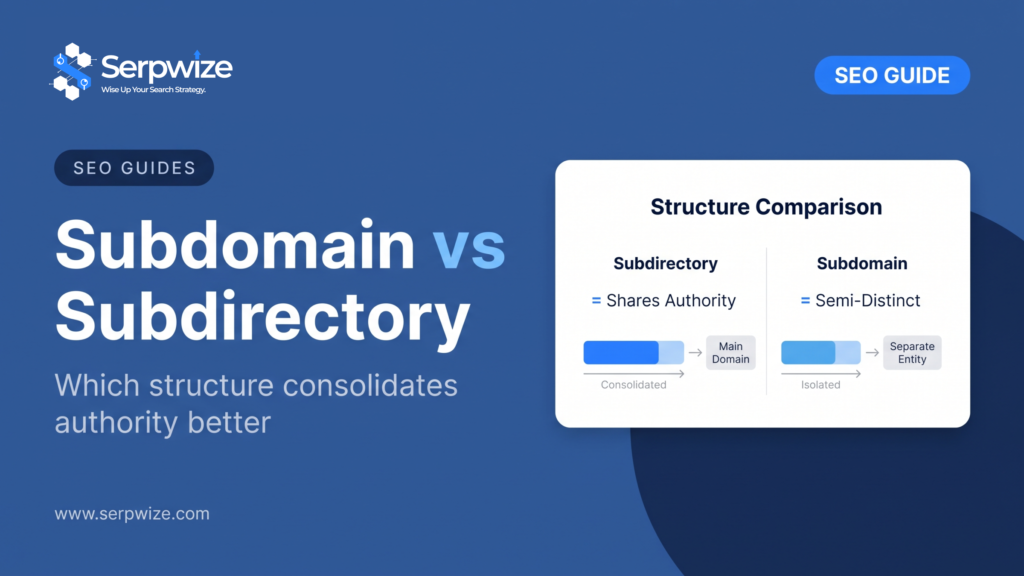
Subdomain vs subdirectory is a structural decision that affects how search engines treat authority across sections of a site – a blog, a help centre, an international version – and the two are not treated identically despite Google’s public statements that they are equivalent.
What Each Actually Is
| Subdirectory | Subdomain | |
|---|---|---|
| Example | example.com/blog | blog.example.com |
| Authority | Shares the main domain’s authority directly | Often treated as a semi-distinct entity |
| Setup complexity | Simpler, same hosting environment | Can require separate hosting or CMS setup |
Why Subdirectories Usually Win
In practice, most large-scale case studies of subdomain-to-subdirectory migrations show meaningful traffic gains after consolidating content onto the main domain’s subdirectory structure. Google’s systems, despite official statements of equivalence, appear to more reliably pool authority within a single domain than across a subdomain relationship.
When a Subdomain Still Makes Sense
- A genuinely separate product or platform with a distinct technical stack that cannot share the main site’s infrastructure.
- Regulatory or legal separation requirements between business units.
- A help centre or support platform running on dedicated third-party software that only supports subdomain deployment.
Migrating from Subdomain to Subdirectory
This is a significant technical migration requiring careful 301 redirect mapping, updated internal links, and monitoring for weeks afterward – not a quick DNS change. Rushed subdomain-to-subdirectory migrations are a common source of temporary traffic loss when redirects are incomplete.
Frequently asked questions
Does Google really treat subdomains differently from subdirectories?
Google states they are treated equivalently, but real-world case studies consistently show subdirectory structures consolidating authority more reliably in practice.
Should a blog always be on a subdirectory?
In most cases, yes – a blog on /blog/ benefits directly from the main domain’s authority rather than building a separate authority profile on a subdomain.
Is migrating from subdomain to subdirectory worth the risk?
Usually, if done carefully with complete redirect mapping. The typical outcome across documented case studies is a meaningful traffic increase within a few months.
Serpwize plans and executes subdomain-to-subdirectory migrations with full redirect mapping. See our SEO outsourcing service.