
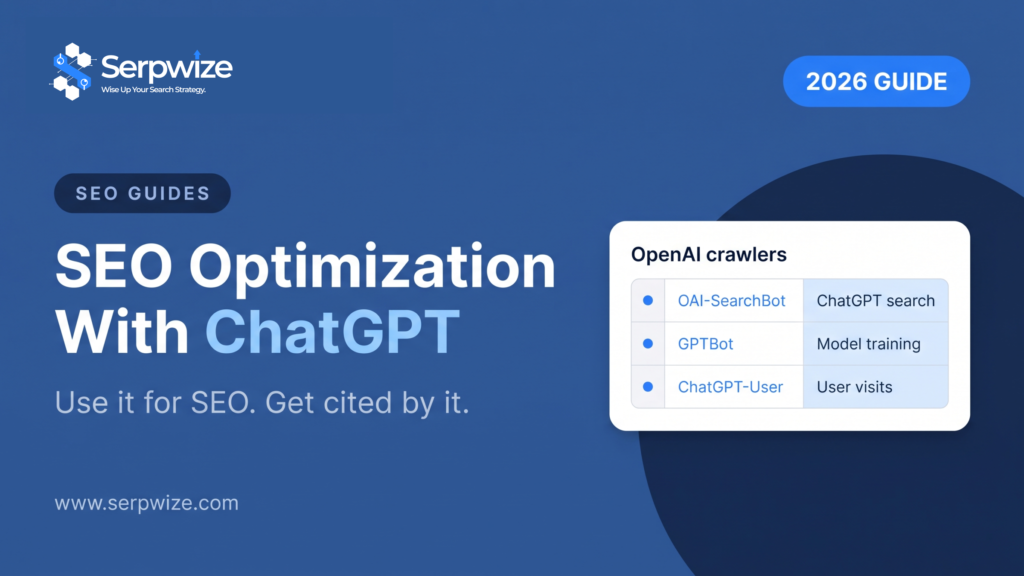
SEO optimization with ChatGPT means two different jobs, and most guides only cover one of them. The first is using ChatGPT to do SEO work faster: keyword ideas, content briefs, meta descriptions, schema drafts. The second is optimizing your own website so ChatGPT finds it, trusts it and cites it when people ask questions in your field. This guide covers both, because a business that only does the first is producing content for a channel it has not prepared for, and one that only does the second is leaving easy time savings on the table.
Everything below comes from our own working process at Serpwize, from OpenAI’s published crawler documentation, and from data we pulled ourselves on 1 October 2026: US search volumes for this topic and the robots.txt rules of the sites that currently rank for it.
What People Actually Search For
The exact phrase “seo optimization with chatgpt” is small, about 10 searches a month in the United States. It belongs to a cluster of near-identical searches that Google treats as one topic, and the cluster is where the demand sits:
| Search term (US) | Monthly searches | Average ad click |
|---|---|---|
| chatgpt for seo | 480 | not enough ad data |
| chatgpt seo | 390 | $34.17 |
| chatgpt seo optimization | 70 | $78.01 |
| chat gpt seo | 70 | $66.27 |
| how to use chatgpt for seo | 50 | not enough ad data |
| chatgpt seo prompts | 40 | $16.68 |
| seo optimization with chatgpt | 10 | not enough ad data |
Source: Google Ads keyword data via DataForSEO, monthly averages for September 2025 to August 2026, pulled 1 October 2026.
Two things stand out. Advertisers pay $78.01 for a single click on “chatgpt seo optimization”, which tells you agencies are selling this as a service, not just writing about it. And interest is uneven: “chatgpt for seo” reached 880 searches in both September 2025 and March 2026, then fell to 170 in August 2026. People come to this topic in waves, usually after a new model release, so a guide needs to stay accurate long after the news cycle moves on.
Part 1: How to Use ChatGPT for SEO
ChatGPT for SEO works best as a fast assistant for drafting, sorting and checking, and worst as a source of facts. A useful rule: let it handle language and structure, and never let it supply a number you have not verified somewhere else.
Keyword research: ideas yes, volumes no
ChatGPT is good at expanding a seed term into the phrases real customers use, grouping a long keyword export into topics, and spotting which terms share a search intent. It does not have access to Google’s search volume or keyword difficulty data, so any volume it quotes is an estimate at best and an invention at worst. Every figure in the table above came from a keyword tool, not from a chat window. Use ChatGPT to build the list, then check demand in Google Keyword Planner, Search Console or a paid tool.
Content briefs and outlines
Paste in the headings of the pages that currently rank, your own notes and your audience, and ask for a brief: the questions the page must answer, the order that makes sense, and what the ranking pages leave out. The gaps are the valuable part. A brief built this way takes minutes instead of an hour, though the decision about what your page will say that nobody else says still has to come from someone who knows the subject.
Titles, meta descriptions and alt text
These are short, rule-bound pieces of writing, which is exactly where ChatGPT saves the most time. Give it the character limits, the target phrase and the page’s actual content, and ask for several options. Then choose the one that is accurate, not the one that sounds most exciting. Our guide to alt text for SEO covers what a good image description needs.
Schema markup drafts
ChatGPT can turn a page’s details into a first draft of JSON-LD for FAQPage, Product, LocalBusiness or Article markup. It also produces confident errors: properties that do not exist, required fields left out, or values that do not match the page. Run every draft through Google’s Rich Results Test and the Schema Markup Validator before it goes live, and only mark up content that visitors can actually see on the page.
Technical helpers
Regular expressions for filtering Search Console reports, redirect rules for a site migration, robots.txt drafts and spreadsheet formulas are all quick wins. Test each one on a copy or a small sample first. A redirect rule that looks right and loops is worse than no rule at all.
Five prompts we use, and why they are written this way
Each prompt gives ChatGPT the material to work from instead of asking it to remember facts, and each asks for a format that is easy to check.
- Clustering: “Here are 200 keywords with their monthly volumes. Group them by search intent, not by shared words. Put each keyword in exactly one group, name each group by what the searcher wants to achieve, and list any keyword you are unsure about separately.”
- Brief gaps: “Below are the H2 and H3 headings from the five pages ranking for [keyword]. List the questions all five answer, the questions only one or two answer, and the obvious questions none of them answer.”
- Meta descriptions: “Write five meta descriptions under 155 characters for the page text below. Each must state one specific fact from the page. Do not use the words ‘ultimate’, ‘comprehensive’ or ‘discover’.”
- Schema draft: “Create FAQPage JSON-LD using only the questions and answers below, word for word. Do not add questions. Flag anything that would fail Google’s structured data guidelines.”
- Self-check: “Read this draft as a sceptical expert in [field]. List every claim that needs a source, every sentence that could appear on any competitor’s site, and every place where a specific example would be stronger than the general statement.”
Where ChatGPT gets SEO wrong
Google’s position on AI-generated content is that it rewards helpful content however it was produced, but using automation mainly to manipulate rankings breaks its spam policies. Its scaled content abuse policy, added in March 2024, covers mass-produced pages that add little value, whether written by people, AI or both. The practical risk is not that Google detects ChatGPT. It is that ChatGPT, asked for twenty similar pages, produces twenty pages that say the same thing in slightly different words. Before publishing a batch of related pages, we compare them against each other for repeated six-word phrases and rewrite anything that overlaps heavily, because near-duplicate pages are the pattern that gets a whole group quietly dropped from the index. For writing that reads like a person wrote it, our SEO copywriting guide goes deeper.
Part 2: How to Optimize Your Website for ChatGPT
Optimizing for ChatGPT, sometimes called ChatGPT SEO, generative engine optimization or answer engine optimization, is about getting your pages read, understood and cited when ChatGPT answers a question. Much of it is ordinary good SEO. A few parts are specific to how OpenAI’s systems reach the web.
Let the right OpenAI crawlers in
OpenAI documents separate crawlers, each controlled independently in robots.txt:
- OAI-SearchBot decides whether your site can appear in ChatGPT’s search answers. OpenAI states that sites opted out of it will not be shown in those answers, though they can still appear as navigational links. If you want to be cited, allow it.
- GPTBot collects content that may be used to train OpenAI’s models. Blocking it does not remove you from ChatGPT search, so a business can opt out of training and still be eligible for citations.
- ChatGPT-User fetches a page when a user asks ChatGPT to visit it. OpenAI notes that robots.txt rules may not apply to these user-initiated visits, and this agent does not decide search inclusion.
- OAI-AdsBot checks landing pages submitted as ads in ChatGPT. It only visits pages submitted as ads.
OpenAI says changes to robots.txt take about 24 hours to reach its search systems. If you use a firewall or bot-protection service, check that it is not blocking OpenAI’s published IP ranges, because a blocked request looks the same to ChatGPT as a site that does not exist.
What we found in the robots.txt files of sites ranking for this topic
On 1 October 2026 we fetched the robots.txt file of every site ranking on page one for “seo optimization with chatgpt”, plus the sources cited in Google’s AI Overview for that search and SEO Sherpa, whose guide on this topic ranks for related searches. One page-one site, Upgrow, refused our request, so it is not included:
- Most marketing sites had no OpenAI-specific rules at all, which means all OpenAI crawlers are allowed by default. That included Search Engine Land, Exploding Topics, HubSpot Community, SEO Sherpa, Apiary Digital, TriMark Digital, MRS Digital and our own site.
- One software company, Ryze AI, named GPTBot, OAI-SearchBot and ChatGPT-User explicitly and allowed all three, keeping only its API and build folders off limits.
- LinkedIn blocks GPTBot and ChatGPT-User completely, but lets OAI-SearchBot crawl everything except public profiles and people search. LinkedIn posts can surface in ChatGPT search while staying out of model training.
- Reddit’s public robots.txt disallows every crawler that does not have its own agreement. Reddit licenses its data to Google and to OpenAI through separate deals, which is why Reddit threads still appear in AI answers.
The lesson for a business site is that the default is already open. The common mistakes are not in robots.txt but in security plugins and CDN bot rules that block unfamiliar crawlers without anyone noticing.
Get indexed where ChatGPT search looks
OpenAI describes ChatGPT search as combining its own crawler with third-party search providers, and Microsoft Bing is the provider most widely reported. Bing visibility is cheap insurance: verify your site in Bing Webmaster Tools, submit your XML sitemap and turn on IndexNow if your CMS supports it, so new and updated pages are picked up quickly.
Write pages an answer engine can quote
ChatGPT tends to quote pages that answer a question directly and back it up. In practice that means:
- Open each section with a one or two sentence answer, then explain.
- Use headings phrased the way people ask questions.
- Give specific numbers with a date and a source, as in the table above.
- Define terms plainly the first time you use them.
- Put comparisons in tables rather than long paragraphs.
- Keep one page per topic, so there is one clear page to cite instead of three partial ones.
Be the same business everywhere
AI systems connect information about you from many sources. If your business name, address, services and founders are described the same way on your website, Google Business Profile, LinkedIn, directories and review sites, those sources reinforce each other. Organization schema with sameAs links to your real profiles, a detailed About page and named authors with their own pages all help an answer engine decide that a page is yours and that you know the subject.
Earn mentions on sites ChatGPT already trusts
Being written about by industry publications, reviewed on independent platforms and quoted by journalists gives AI systems third-party confirmation that a page alone cannot. Wikipedia is a strong source, but its conflict-of-interest rules mean a business should not write its own article. Coverage has to come from genuine notability. Our off-page SEO guide explains how digital PR and mentions work alongside links.
Measure what ChatGPT sends you
Links clicked in ChatGPT answers commonly carry utm_source=chatgpt.com, so visits show up in Google Analytics 4 under that source. Create a simple report for it. Visibility without clicks is harder to measure, so keep a fixed list of 20 to 30 questions your customers ask, run them in ChatGPT once a month, and record whether your business is named and which sources are cited. The trend matters more than any single answer, because responses vary from one run to the next. Our guide to AI search visibility challenges for SEO teams covers the new Bing and Google AI reports in detail.
What About llms.txt?
llms.txt is a proposed file, suggested in September 2024, that lists a site’s most useful pages for language models in plain Markdown. It is harmless to add and quick to create. OpenAI’s crawler documentation does not mention it, so treat it as optional and spend your time on crawler access, page quality and mentions first.
A 30-Day Plan
- Week 1: Check robots.txt, firewall and CDN settings for OAI-SearchBot access. Verify your site in Bing Webmaster Tools and submit your sitemap.
- Week 2: Pick your 10 most important pages. Rewrite each opening paragraph so it answers the main question directly, and add a dated source to every statistic.
- Week 3: Align your business details across your site, Google Business Profile, LinkedIn and the top directories in your field. Add Organization schema with
sameAslinks. - Week 4: Set up a GA4 report for ChatGPT traffic, write your list of customer questions, and record your first monthly ChatGPT visibility check.
Frequently Asked Questions
Can ChatGPT do SEO optimization on its own?
No. ChatGPT can draft titles, meta descriptions, outlines and schema, and it can sort large keyword lists quickly. It cannot see your rankings, crawl your site the way a search engine does, or access real search volume data. Treat it as a fast assistant whose work needs checking, not as a replacement for SEO tools or judgement.
Will Google penalize content written with ChatGPT?
Google says it rewards helpful content regardless of how it was made. What breaks its spam policies is using automation mainly to manipulate rankings, including mass-producing near-identical pages. Content drafted with ChatGPT, then checked, improved with real examples and edited by someone who knows the subject, is treated like any other content. Our guide to whether Google ranks AI content sets out Google’s position in full.
How do I get my website to show up in ChatGPT answers?
Allow OAI-SearchBot in robots.txt and your firewall, make sure your pages are indexed in Bing, write pages that answer questions directly with dated sources, keep your business details consistent across the web, and earn mentions on independent sites. There is no way to pay for organic citations, and no guarantee of being named in any given answer.
Should I block GPTBot?
That depends on whether you are comfortable with your content being used to train OpenAI’s models. Blocking GPTBot does not stop OAI-SearchBot, so you can opt out of training and still appear in ChatGPT search. Most businesses that want AI visibility allow OAI-SearchBot either way.
How can I see how much traffic ChatGPT sends to my site?
In Google Analytics 4, look for sessions with the source chatgpt.com, which appears because links in ChatGPT answers commonly carry that UTM tag. Mentions without clicks need a manual check: run a fixed set of customer questions in ChatGPT each month and record whether you are named.
Does ChatGPT give accurate keyword search volumes?
No. ChatGPT does not have access to Google’s keyword data, so the volumes it gives are guesses. Use it to generate and group keyword ideas, then check volumes and difficulty in Google Keyword Planner, Search Console or a dedicated keyword tool.
Related reading: AI SEO vs Traditional SEO: What Actually Differs and Will AI Replace Outsourced SEO?
Want to know whether ChatGPT can find and cite your business today? Our AI SEO and GEO services start with a free audit of your crawler access, entity consistency and citation visibility.